
Understanding the Emerging Relationship
Public Summary Report – May 2026
Venice AI (VVVUSD)* and Bittensor (TAOUSD)* are increasingly being discussed together within the decentralized artificial intelligence ecosystem. While the two projects are not merged entities and do not appear to have a formal ownership relationship, there is growing evidence that Venice AI may utilize portions of the Bittensor subnet infrastructure as part of its backend AI architecture.
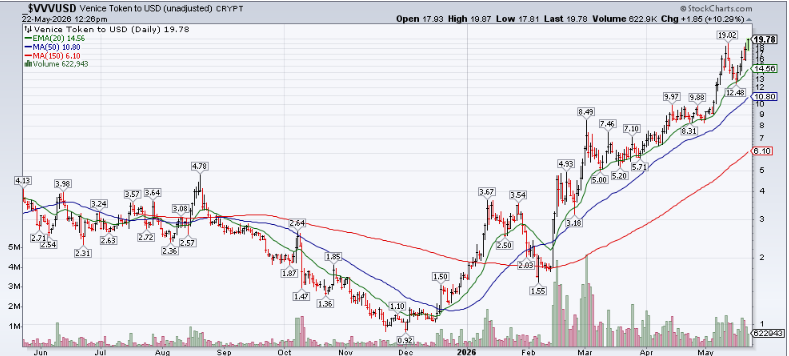
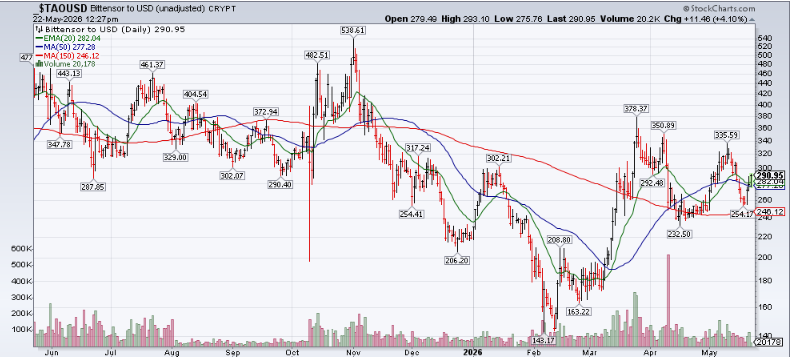
High-Level Relationship
Venice AI functions primarily as a consumer-facing AI platform focused on privacy, decentralized access, and user interaction.
Bittensor (TAO) functions as a decentralized AI infrastructure and incentive network that coordinates AI miners, validators, and specialized subnets.
Recent ecosystem commentary suggests that Venice AI may leverage Bittensor subnets for inference and verification workloads, particularly within certain specialized AI subnets.
How Venice AI Benefits from Bittensor
- Access to decentralized AI infrastructure: By utilizing decentralized compute and intelligence networks, Venice may reduce reliance on large centralized cloud providers while gaining scalable AI capacity.
- Privacy and decentralization alignment: Both projects emphasize decentralization, censorship resistance, and user sovereignty, creating strong philosophical alignment.
- Flexible AI routing: Bittensor’s subnet structure allows Venice to potentially access multiple specialized AI systems rather than relying on one monolithic model provider.
- Faster experimentation: A decentralized AI ecosystem may allow Venice to test and integrate emerging AI capabilities more rapidly.
How Bittensor (TAO) Benefits from Venice AI
- Consumer-facing adoption: One of the largest challenges for decentralized AI systems is demonstrating real-world usage. Venice potentially provides an end-user application layer that can generate actual AI demand.
- Validation of the ecosystem: If a recognized AI platform chooses Bittensor infrastructure, it supports the argument that decentralized AI networks may have commercial viability.
- Increased subnet activity: Growing application demand could increase economic activity across Bittensor subnets, potentially strengthening staking and token utility dynamics.
- Expansion of the decentralized AI narrative: The relationship supports the broader concept of consumer AI applications operating on decentralized infrastructure.
Strategic Interpretation
The Venice AI and Bittensor relationship is strategically interesting because it may represent an early example of a layered decentralized AI ecosystem:

If this model succeeds, decentralized AI systems could evolve beyond speculative tokens into functioning infrastructure economies with real consumer demand.
Risks and Considerations
- The relationship may remain experimental and could evolve over time.
- Consumer adoption remains the key long-term metric, not social media excitement.
- Bittensor’s technical complexity may slow mainstream adoption.
- Competition from centralized AI providers remains extremely strong.
- AI crypto narratives can move ahead of real revenue generation and user growth.
Overall Assessment
The emerging relationship between Venice AI and Bittensor is noteworthy because it suggests that decentralized AI infrastructure may begin supporting real consumer-facing applications. For supporters of Bittensor, developments like this may be viewed as early evidence that the network is progressing from theory and speculation toward practical utility.
Prepared for public discussion and educational purposes.
May 2026
#crypto #veniceai #bittensor #altcoin #tao #vvv
LOTM Research & Consulting Service
* An account related to LOTM holds a position in this security.
Neither LOTM nor Tom Linzmeier is a Registered Investment Advisor.
Please refer to our web site for full disclosure at www.LivingOffTheMarket.com ZTA Capital Group, Inc.
To Unsubscribe please select “return” and type Unsubscribe in the subject line.
