
Written April 27, 2026
Reasons for considering Lien Chicago Atlantic BDC:
- The dividend is attractive: about 14% annualized
- Revenue has been strong: Increasing 1,653.42% over the past 3/5 years and up 151.5% TTM
- Earnings are strong: Increasing 137.2% TTM
- Margins are strong:
Gross margin: 77.26%
Operating Margin: 63.59%
Profit margin: 61.29%
About Lien Chicago Atlantic BDC (LIEN*) $9.45 –
Chicago Atlantic BDC, Inc. (NASDAQ: LIEN) is a specialty finance company focused on originating, underwriting and deploying primarily first-lien, senior-secured fixed and floating rate debt primarily to the cannabis industry’s most established operators and to other niche companies overlooked by the broader market. LIEN focuses on opportunities that are time-sensitive, highly complex or in dislocated sectors where risk is fundamentally mispriced with attractive risk-adjusted returns. LIEN is led by a seasoned investment team with decades of multi-sector experience across market cycles and complex legal and regulatory frameworks in credit, special situations, equities, distressed and emerging market debt.
One-year chart: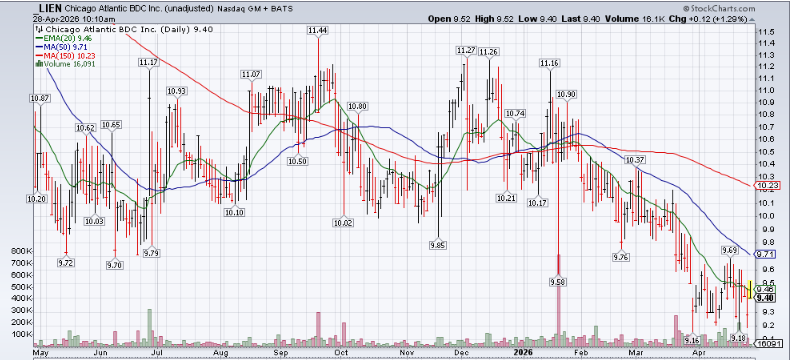
Finviz link here for chart, news, analysts and Stats as shown below.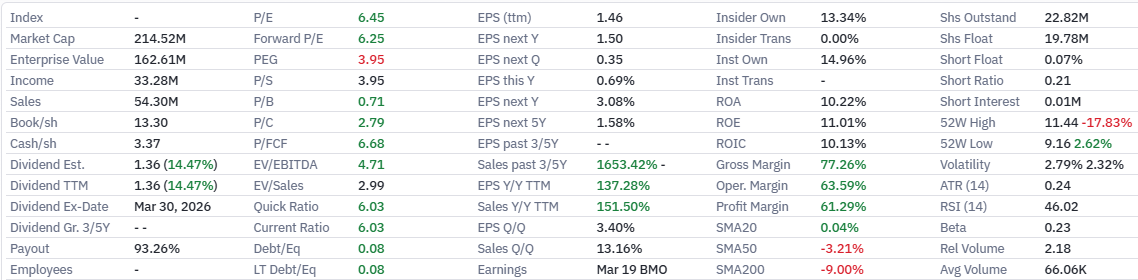
- Pros and cons of owning this company for the next twelve-months.
- Are their property mortgages / loans considered private capital and at risk
Owning Chicago Atlantic BDC (LIEN) for the next twelve months involves balancing a high dividend yield and deep valuation discount against significant sector concentration risks. While its loans are primarily senior secured, they are considered “private capital at risk” because they are direct loans to privately held companies with limited traditional financing options.
Analyst Pros and Cons (Next 12 Months)
Analysts generally view LIEN as an undervalued “income play” with a 13-14% dividend yield, though market skepticism persists regarding its niche focus.
Pros
- Deep Valuation Discount: The stock trades at a 20-25% discount to its Net Asset Value (NAV) of roughly $13.27–$13.30 per share. This creates a “margin of safety” for investors if asset quality remains stable.
- High, Covered Dividends: LIEN provides an annual dividend yield of approximately 13.5% to 14.6%. Recent quarterly earnings show the dividend is fully covered by net investment income (NII).
- Senior Secured Positioning: Approximately 99.5% of the portfolio is senior secured debt, which sits at the top of the capital structure and offers better protection in case of borrower default.
- Diversification Strategy: Management is actively reducing cannabis exposure, with non-cannabis loans reportedly growing to roughly 24-30% of the portfolio by early 2026.
Cons
- Sector Concentration: Despite diversification efforts, roughly 70-76% of the portfolio remains exposed to the cannabis industry, which faces severe federal tax burdens (Section 280E) and regulatory uncertainty.
- Portfolio Stress Signals: Some analysts have noted rising expenses and a growing reliance on Payment-in-Kind (PIK) interest, which can signal that some borrowers are struggling with cash flow.
- Low Liquidity: As a micro-cap company with low daily trading volume (typically under 80,000 shares), it may be difficult for large investors to exit positions quickly.
- Regulatory Reliance: A failure or delay in federal cannabis rescheduling could lead to significant downside and potential loan defaults.
- Are Loans Considered Private Capital and at Risk?
Yes. LIEN’s property mortgages and loans are classic examples of private credit.
- Target Market: They lend to privately held middle-market companies that are often underserved by traditional banks due to federal restrictions related to being involved in cannabis.
- Risk Profile: Because these borrowers cannot access standard bank capital, LIEN can charge higher interest rates (averaging 15.8% yield) to compensate for the higher perceived credit and regulatory risk.
- Risk Mitigation: While the capital is “at risk,” the company uses strict loan covenants, personal guarantees, and collateral—such as real estate or licenses—to mitigate potential losses.
Analysts currently have an average 12-month price target of approximately $11.00, suggesting potential upside from current levels if they maintain portfolio stability.
- A more detailed breakdown of their quarterly dividend coverage or their non-cannabis sector growth.
Chicago Atlantic BDC (LIEN) has significantly improved its financial stability heading into 2026, driven by a strategic shift toward non-cannabis diversification and more consistent dividend coverage.
Quarterly Dividend Coverage (2025–2026)
The company has stabilized its dividend at $0.34 per share for six consecutive quarters. Recent financial performance indicates the dividend is well-supported by Net Investment Income (NII).
- FY 2025 Performance: For the full year 2025, LIEN reported NII of $1.45 per share, comfortably exceeding the total annual dividend of $1.36.
- Recent Quarterly NII Trends:
- Q4 2025: $0.36 per share (106% coverage).
- Q3 2025: $0.42 per share (123% coverage).
- Outlook for 2026: The board has already declared a $0.34 dividend for the quarter ending March 31, 2026. Management maintains a conservative leverage profile (0.08x–0.10x debt-to-equity) to ensure the payout remains protected even if market interest rates fluctuate.
Non-Cannabis Sector Growth
LIEN is aggressively rotating its portfolio to reduce its reputation as a “cannabis-only” lender. As of early 2026, approximately 25% to 30% of the portfolio is invested in non-cannabis companies.
- Diversification Progress: Non-cannabis exposure grew from roughly 24% in Q3 2025 to 25% by year-end. Some analyst reports suggest the strategic shift is aimed at reaching a 76% non-cannabis mix over the long term through aggressive capital recycling.
- Current Non-Cannabis Targets:
- Finance and Insurance: 37% of the non-cannabis segment.
- Retail Trade: 26%.
- Real Estate: 15%.
- Deal Pipeline: The company reports a total pipeline of $732 million, with $116 million (roughly 16%) currently dedicated to new non-cannabis opportunities.
- Portfolio Resilience
A key part of their strategy is protecting income as interest rates drop. Approximately 73% of the debt portfolio is now insulated from further rate declines because the loans are either fixed-rate or have already reached their “interest rate floors”. Additionally, the company currently maintains zero non-accruals, meaning all borrowers are currently making their scheduled payments.
- What are LIEN’s yield and valuation compared to other popular BDCs like Main Street Capital (MAIN) or Ares Capital (ARCC)?
As of late April 2026, Chicago Atlantic BDC (LIEN) offers a significantly higher “risk-adjusted” yield compared to industry giants like Main Street Capital (MAIN) and Ares Capital (ARCC), but it trades at a steep discount due to its smaller size and niche focus.
2026 Peer Comparison: LIEN vs. MAIN vs. ARCC
Metric |
Chicago Atlantic (LIEN) |
Ares Capital (ARCC) |
Main Street (MAIN) |
Dividend Yield |
~14.5% |
~10.3% |
~5.6% |
Price to NAV |
~0.75x (Discount) |
~0.91x (Discount) |
~1.45x (Premium) |
Portfolio Focus |
Cannabis & Specialty |
Diversified Middle Market |
Lower Middle Market |
Non-Accruals |
0% |
1.7% |
3.9% |
Key Takeaways for Investors
- Valuation vs. Quality:
- MAIN is often called the “Gold Standard” and trades at a massive premium (up to 70% over its asset value) because of its internally managed structure and long history of NAV growth.
- ARCC is the market leader by size ($13B+ market cap) and is currently viewed by many analysts, like those at RBC Capital, as a top “blue-chip” pick for 2026 due to its scale and dominant market position.
- LIEN trades at the deepest discount (roughly 25% below its book value), offering the highest potential for capital appreciation if the market begins to reward its non-cannabis diversification efforts.
- Risk Profiles: Despite its niche focus, LIEN currently boasts zero non-accruals, which is objectively better than MAIN (3.9%) and ARCC (1.7%) in the most recent reporting cycle. This suggests that LIEN’s strict senior-secured underwriting is currently outperforming larger peers in terms of loan quality.
- Yield Reliability: While ARCC and MAIN have maintained or increased dividends for years, LIEN provides much higher “income per dollar” spent, though its smaller size makes it more sensitive to individual borrower defaults.
- LIEN’s specific loan-to-value (LTV) ratios
Comparing Loan-to-Value (LTV) ratios across these BDCs reveals why Chicago Atlantic (LIEN) offers a much higher yield. While “blue-chip” BDCs like Ares and Main Street lend against cash flow with moderate leverage, LIEN uses much stricter asset-backed structures to manage its higher-risk sector exposure.
Loan-to-Value (LTV) & Portfolio Cushion Comparison (2026)
Metric |
Chicago Atlantic (LIEN) |
Ares Capital (ARCC) |
Main Street (MAIN) |
Typical LTV Ratio |
~45% – 50% |
~50% – 60% (Estimated) |
~50% – 55% |
Collateral Basis |
Hard Assets (Real Estate, Licenses) |
Enterprise Value (Cash Flow) |
Enterprise Value (Cash Flow) |
Asset Type |
Senior Secured (1st Lien) |
Mixed (1st Lien & 2nd Lien) |
Primarily 1st Lien |
Portfolio Leverage |
0.08x (Ultra-Low) |
1.12x (Standard) |
0.95x (Standard) |
Key Insights into the “Cushion”
- LIEN’s “Safety First” Approach: Because LIEN lends to the cannabis industry, it cannot rely on traditional bankruptcy protections. To compensate, it maintains a massive equity “cushion.” If a borrower defaults, LIEN typically only has $0.45 to $0.50 lent for every $1.00 of collateral value. This deep collateralization is why they currently report zero non-accruals.
- MAIN’s Asset Focus: Main Street Capital (MAIN) often focuses on “lower-middle-market” companies. Recent reports show they maintain a disciplined 55% LTV on certain asset classes like multifamily loans. This provides a strong buffer, though their non-accruals (loans in trouble) are currently higher than LIEN’s at 4.0% of cost.
- ARCC’s Scale: Ares Capital (ARCC) is the largest BDC and lends to much bigger companies. While they don’t always report a singular “LTV” (as they lend against a company’s total earnings, not just hard assets), their portfolio is considered “gold standard” because they use four independent valuation firms to verify their asset marks.
- Leverage Warning: The biggest difference is how much debt the BDC itself uses. LIEN has almost no debt of its own (0.08x ratio), meaning it doesn’t need to take big risks to pay its dividend. ARCC and MAIN use significant leverage (~1.0x) to boost their returns.
Summary: LIEN is a “defensive” lender in an “offensive” sector. By lending only half the value of a property or business, they have a massive buffer even if their specific industry (cannabis) faces headwinds over the next year.
- What specific types of collateral (real estate vs. equipment) that LIEN holds in its latest portfolio report?
Chicago Atlantic BDC (LIEN) utilizes a multi-layered collateral strategy that distinguishes it from traditional BDCs. While peers like Main Street Capital primarily lend against a company’s future cash flows, LIEN’s loans are strictly asset-backed, meaning they are secured by “hard” collateral that can be liquidated if the borrower fails.
Collateral Breakdown by Type (2026 Strategy)
LIEN’s portfolio is structured to provide a “safety net” through the following specific asset types:
- Real Estate (Primary Collateral): This remains the anchor for most loans. LIEN typically takes a first-lien mortgage on the borrower’s cultivation facilities, dispensaries, or industrial warehouses. Because these properties are often specialized, LIEN keeps its Loan-to-Value (LTV) at roughly 45%–50% to ensure they can recover the loan amount even in a forced sale.
- State Cannabis Licenses: In the cannabis sector, the license itself is often more valuable than the building. LIEN frequently secures loans with an equity pledge over the borrower’s state-issued operating licenses, providing a critical layer of control in “limited-license” states where new competitors cannot easily enter.
- Equipment & Inventory: For its newer non-cannabis and technology-focused loans, collateral often includes specialized equipment (like manufacturing lines) or high-value inventory.
- Corporate Equity Pledges: To further reduce risk, management often requires the borrower’s owners to pledge their entire ownership stake in the company as additional security.
Collateral “Cushion” vs. Peers
Collateral Asset |
LIEN Strategy |
Traditional BDC (MAIN/ARCC) |
Real Estate |
Required for almost all loans. |
Often secondary or not required. |
LTV Ratio |
45% – 50% (Conservative) |
65% – 75% (Standard for CRE) |
Valuation Basis |
Liquidation value of hard assets. |
Enterprise value (multiples of EBITDA). |
Recent Portfolio Rotation
As of Q1 2026, LIEN is increasingly moving into Niche Credit outside of cannabis, including Business Process Outsourcing (BPO) and AI support platforms. In these cases, the collateral shifts from real estate toward cash-flow-backed assets and accounts receivable, though they maintain their strict “senior secured” requirement for 100% of new originations.
Summary: LIEN’s collateral is essentially a “double-lock” system. They lend against the property (Real Estate) and the right to do business (Licenses), ensuring that even if a borrower’s cash flow drops, the underlying assets provide significant recovery value.
Three-year weekly chart: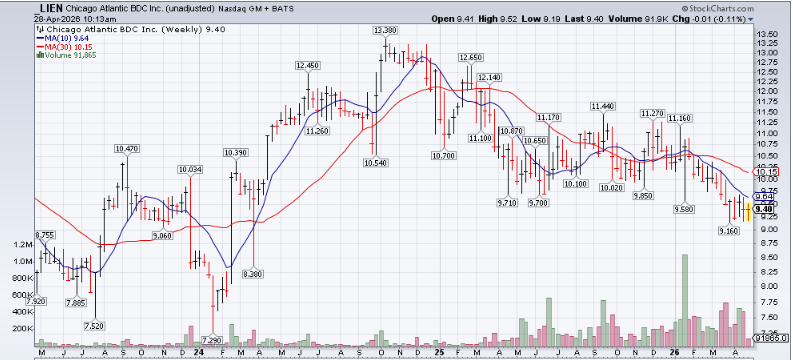
Lien Chicago Atlantic is a small company, making it ineligible for most institutional investors. There is a wider than normal bid-ask spread, so using limit orders is recommended. The stock trades below asset value due to its association with unpopular private capital sentiment. Despite negative sentiment, current revenue, earnings, and margins suggest a potential buying opportunity.
LOTM Research & Consulting Service
* An account related to LOTM holds a position in this security.
Neither LOTM nor Tom Linzmeier is a Registered Investment Advisor.
Please refer to our web site for full disclosure at www.LivingOffTheMarket.com ZTA Capital Group, Inc.
To Unsubscribe please select “return” and type Unsubscribe in the subject line..
