
Subject: Two Major Catalysts Developing
Date: July 20, 2026 – By LOTM / Tom Linzmeier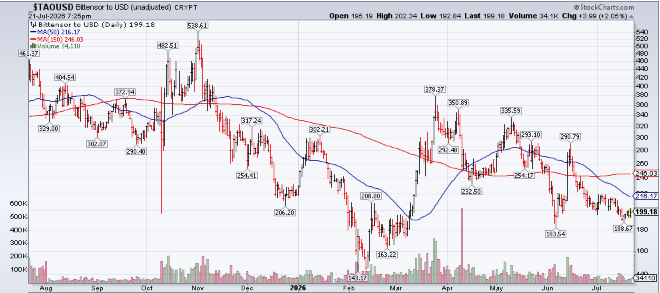
RE: xTAO Inc (XTAIF*) $0.45
Note: XTAIF* & TAO* are LOTM related portfolio positions
XTAIF is the top-rated company in our CIF/DIIF Group 3 – Individual AI/Crypto/Blockchain Companies, for Largest Asymmetrical Price Potential to 2030. Potential upside for this decentralized AI/crypto altcoin is placed between 5X to 20X-plus. Currently, XTAIF is the largest public company holder of TAO altcoins. They are debt free and are earning about 8.8% annual return on their TAO treasury position. This return earned has potential to climb to 12% /14% area. They do have a negative cash flow, but they have large and strong institutional investors backing them. Failure of Bittensor (TAO) to develop and grow could see the price of XTAIF fail and go to zero.
Catalyst #1 happening now:
Question: There are rumors of Kraken listing BitTensor (TAO)*subnets for trading, true or not true?
The rumors are entirely true and have transitioned into live, active token listings. Kraken has officially integrated Bittensor’s Dynamic TAO (dTAO) architecture, becoming the first tier-1 centralized exchange to list individual Bittensor subnet alpha tokens for trading.
What Is Happening
- Official Integration: Kraken completed a native integration of Bittensor’s dTAO framework.
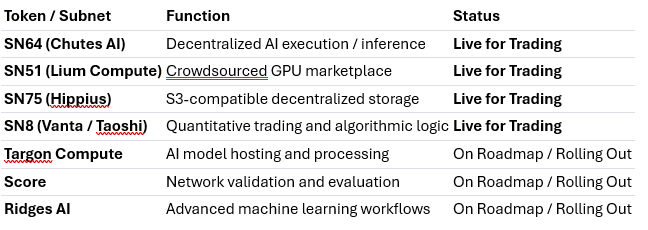
- The 7-Subnet Plan: Kraken initially added seven subnet alpha tokens to its public asset roadmap.
- Live Trading: Several of these subnet tokens have already moved from the roadmap to active trading.
- Spot TAO Support: Kraken also added direct spot trading support for the core Bittensor (TAO) token with major fiat pairs on Kraken Pro.
Which Subnets Are Listed or Launching?
The tokens span various layers of Bittensor’s decentralized artificial intelligence stack, including data storage, specialized compute, and AI applications:
Why This Matters Mechanically
The listing structure introduces a massive structural catalyst for the underlying Bittensor ecosystem:
- Hidden Buying Pressure for TAO: Each Bittensor subnet functions as an Automated Market Maker (AMM) paired directly against TAO. When a retail trader purchases a subnet token (like SN64) on Kraken using fiat or stable coins, Kraken must back that liquidity on-chain. This means Kraken implicitly buys TAO, routes it to the subnet’s AMM pool, and swaps it for the alpha token, driving up the price of both assets.
- Access to Cheaper Assets: Mainframe TAO tokens trade at higher triple-digit prices, which can psychologically deter retail investors. Individual subnet tokens are priced significantly lower (often ranging from under a dollar to $15), allowing smaller retail participants to easily gain targeted exposure.
- Targeted AI Investing: Rather than buying the entire Bittensor network via TAO, investors can now isolate and place distinct financial bets on specific AI use cases, such as purely betting on GPU compute (SN51) or data storage (SN75).
- The combination of the above three actions creates a “flywheel” reaction whereas buying of TAO that then allocates the TAO to the BitTensor subnets, creates demand for TAO and then demand for the subnet while also removing the said BitTensor altcoins from circulation while they are on loan to the subnet.
Key Trading Disclaimers
- Liquidity Windows: Trading via the standard Kraken App and Instant Buy features rolls out dynamically for each subnet once organic market depth and liquidity conditions are satisfied.
- Inherent Risks: Subnet tokens carry structural risks. If a subnet fails to perform or is deregistered on-chain by validators, the alpha token undergoes an immediate liquidation haircut, causing its value to decline sharply. This is pure merit-based Capitalism. Succeed or be replaced by a better subnet.
If you plan to trade these assets, you can monitor live subnet metrics and on-chain pool balances using tracking platforms like TaoStats and TaoMarketCap.
Live Network and Subnet Prices
The core Bittensor engine and its primary liquid subnet tokens are currently trading at the following rates (7.20.26):
- Bittensor (TAO): $193.68
- SN64 (Chutes AI): $14.12
- SN8 (Vanta Network): $5.71
Mechanics: How dTAO Staking Works
The launch of dynamic TAO (dTAO) completely overhauls the legacy staking system. Staking is no longer a one-size-fits-all mechanism for the entire network.
1. Token Swaps vs. Native Delegation
- Legacy Staking: You delegated raw TAO to a validator and earned a flat network APR.
- dTAO Staking: You must first swap your TAO for a specific subnet’s alpha token (e.g., SN64) to participate in its unique yield pool.
2. The Automated Market Maker (AMM) Core
- Every subnet operates an on-chain AMM liquidity pool.
- The pool pairs the network’s core asset (TAO) directly against that specific subnet’s token (Alpha).
- When you stake to a subnet, you are programmatically committing your capital into this AMM pair.
3. Dynamic Yield Generation
- Validator Emissions: The root network continually emits TAO to subnets based on performance.
- Alpha Compounding: Validators inject these fresh emissions directly into the subnet’s AMM pool.
- Yield Distribution: Your stake automatically grows as the pool absorbs these regular validation emissions.
Crucial Yield Risks to Consider
While dTAO staking opens highly targeted yield opportunities, it introduces major economic variables:
- Impermanent Loss: Because subnets use an AMM pricing model, dramatic price decoupling between TAO and your chosen Alpha token can reduce your overall purchasing power upon unstaking.
- Deregistration Liquidation: If a subnet drops to the bottom of the network leaderboard, it faces automated deregistration. This event forces an immediate on-chain liquidation haircut of the remaining Alpha token pool value.
xTAO Inc, the company, owns a 61,250 TAO treasury position that stakes TOA, delegates TAO to specific subnets and acts as a validator to the subnet universe.
Catalyst #2:
Two large and highly regarded companies, GrayScale and Bitwise, have filed registration applications with the SEC to offer BitTensor (TAO) ETFs in the United States. These ETFs are anticipated to be available in the third or fourth quarter of 2026. These are the first two ETFs in the USA to offer BitTensor ETFs.
Both companies are expected to stake the BitTensor they hold to the subnets and return the yield back to the owners of the ETF. There are expenses to do this, but the yield returned to shareholders of the ETF is estimated to be 5% to 7%. GrayScale is anticipated to stake BitTensor sooner than Bitwise as they have their own staking and Validation company already in operation.
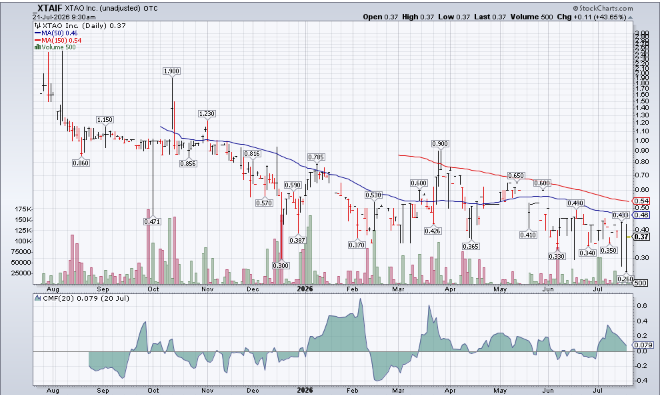
In this stage of company development xTAO Inc. must be considered a Venture Capital style investment. There is no exit (sale) value of the shares that is either liquid or attractive. We suggest if interested that you plan for a 24 holding period.
Weakness in price is an opportunity to buy if you are accumulating shares. It is recommended that owners of xTAO Inc sell one third to half their position when they can recover their original money invested.
Promotional Marketing – There is a lot of promotional marketing currently around BitTensor. There is always some truth but there is a high degree of exaggeration around TAO as well.
If you listen the videos in the link here – discount the excitement and exaggeration and but also realize that there is truth included in the vids. The nine videos linked above were all released in the past week and is the first “page” of TAO on YouTube released in the past week.
Note:
CIF (Comprehensive Investment Framework) is a repeatable investment research methodology used to compare investments across multiple industries using consistent measures of business quality, financial strength, competitive position, capital structure, and long-term catalysts.
DIIF (Digital Infrastructure Investment Framework) is the Digital Infrastructure specialization of the CIF methodology. It evaluates companies, ETFs, and digital assets that are building or enabling the infrastructure of the digital economy, including AI, blockchain, tokenization, digital finance, data centers, and related technologies.
CIF seeks to identify businesses that can create durable long-term value. DIIF applies that discipline specifically to the emerging infrastructure of the digital economy.
#digitalassets #crypto #digitaltreasuries #blockchain
LOTM Research & Consulting Service
* An account related to LOTM holds a position in this security.
Neither LOTM nor Tom Linzmeier is a Registered Investment Advisor.
Please refer to our web site for full disclosure at www.LivingOffTheMarket.com ZTA Capital Group, Inc.
To Unsubscribe please select “return” and type Unsubscribe in the subject line.
