
Written Aug 13 – published August 14 – Q3 earnings announcement Aug 12. Produced by LOTM/Tom Linzmeier with AI assist.
Summary
- CIF ranking Improved to 9.00 / 10
- DIIF ranking Improved to 9.2 / 10
- WormHole Potential ranking improving to 9.4 / 10
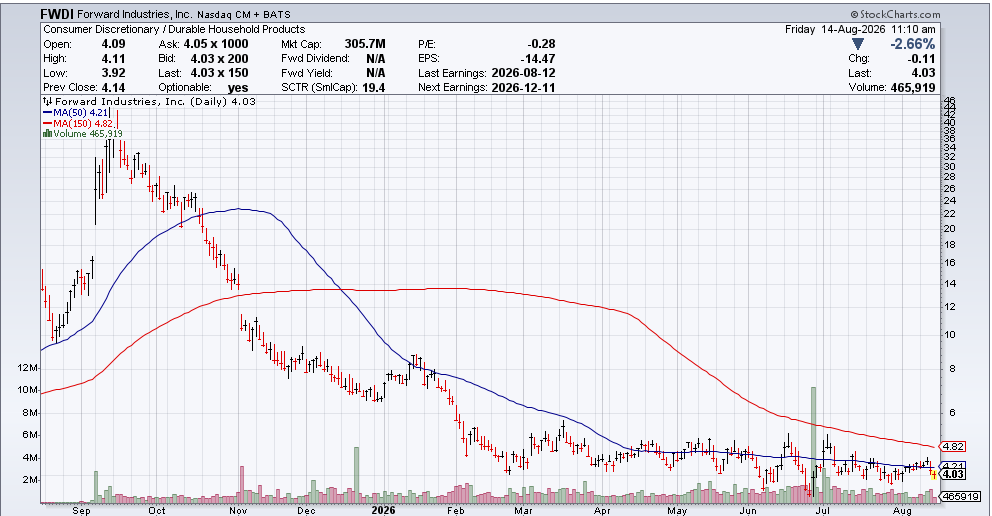
Our work in applying CIF / DIIF / WormHole analysis to Forward Industries (FWDI)
TOM to Chat – RE: Forward Industries Conference call and earnings are released. Please run FWDI through our CIF – DIIF – Wormhole analysis: https://seekingalpha.com/article/4935863-forward-industries-inc-fwdi-q3-2026-earnings-call-transcript
CHAT: After reviewing the newly released Q3 earnings, the conference call, and the balance-sheet/capital-structure information, my conclusion is favorable:. FWDI strengthened its CIF/DIIF case this quarter despite the ugly GAAP loss. More importantly, it strengthened the specific part of the thesis we care most about: SOL ownership per fully diluted share increased materially without reckless leverage.
FWDI — Q3 2026 CIF / DIIF / Wormhole Review
- Overall conclusion: UPGRADE / conviction increased

The earnings headline — $69 million loss and an $0.80/share loss — badly understates what happened economically. Most of the damage came from $49.8 million of digital-asset losses plus $15.2 million of impairments, largely non-cash valuation effects. Meanwhile, revenue increased 332% to $10.8 million and gross margin improved to 62.2%.
- The most important number: SOL/share
This is the centerpiece of the quarter.
- March 31: 0.0669 SOL/FD share
- June 30: 0.0730
- August 3: 0.0754
That’s roughly +12.7% in about four months, with management calculating the Q3 progression at roughly a 36% annualized growth rate. SOL holdings rose from about 7.0 million at March 31 to 7.55 million at June 30 and approximately 7.81 million SOL by August 3.
This validates the new DAT Capital-Structure Efficiency factor particularly well.
FWDI isn’t merely saying: “We own more SOL.”
The economically meaningful statement is:
Each fully diluted FWDI share now represents ownership of more SOL.
That distinction is enormous. A treasury company can grow its digital assets while destroying shareholder value through dilution. FWDI is demonstrating the opposite.
2. Capital allocation — one of the strongest parts of the report
During Q3, FWDI acquired approximately 403,000 SOL through purchases and earned another 106,000 SOL/SOL-equivalents through staking. Cumulative staking rewards since launching the strategy reached approximately 307,000 SOL. Nearly the entire treasury is staked, and Forward’s validator has grown into a top-10 Solana validator with about 1.8% of network stake weight.
At the same time, management reduced common shares outstanding:
March 31: ~76.3M to q3 end, June 30: 73.8M
Fully diluted shares ended at approximately 103.5M.
That combination — SOL increasing while common shares decline — is exactly what we wanted the DAT sub-score to identify.
3. Leverage remains surprisingly controlled
FWDI ended Q3 with approximately $105 million of debt, carrying an average weighted interest rate of only 2.6%, against $576.6 million of digital treasury assets. Management characterized treasury leverage as mid-to-high teens.
This is a major positive.
The Galaxy relationship is giving Forward something potentially more valuable than simple financing: cheap institutional capital secured against productive crypto assets.
The earlier Galaxy-backed transaction is a good example: FWDI used financing to repurchase more than 6.1 million shares, explicitly increasing SOL/share rather than simply issuing equity to accumulate SOL.
That moves my Capital / Capital Allocation score higher.
4. The sleeper development: FWDI is evolving beyond a SOL treasury
This was probably the most important strategic information in the call.
Management repeatedly described finding opportunities where FWDI can borrow around 2.6% and deploy capital into Solana-based RWA opportunities producing high-single-digit to low-double-digit yields.
OnRe is the first meaningful example.
Management indicated approximately the low-$20-million range has already been deployed toward ONYC, approaching the $25 million commitment. Management also said the investment is producing roughly a 12% net return.
Think about what they are constructing:
Cheap institutional capital → productive Solana assets → staking yield + RWA yield + ecosystem equity stakes → cash flow → additional SOL/share growth.
That is considerably more interesting than:
Raise equity → buy SOL → wait for SOL to appreciate.
And it is why my DIIF score moves above the basic CIF score.
5. Agentic Finance — surprisingly important
This section of the Q&A caught my attention because it intersects directly with the Machine Economy / Agentic Payments work we’ve been developing.
Kyle Samani discussed Coinbase’s x402 and Stripe’s Machine Payments Protocol as infrastructure being adopted on Solana. He also said agentic trading is already occurring through AI-connected Solana trading applications.
But here’s the important FWDI connection:
Forward doesn’t necessarily need to pick the winning agentic-finance application.
Agentic trading generates transactions and MEV.
FWDI stakes SOL.
Therefore, some of that economic activity flows back toward validators/stakers, including Forward. Management explicitly made that connection on the call.
That fits our preferred CIF question almost perfectly:
- Does the company become more valuable as the ecosystem grows regardless of which individual application wins?
Increasingly, my answer for FWDI is yes.
6. M&A could become the Wormhole catalyst
This was the most consequential forward-looking statement in the call.
Management said Forward is actively evaluating acquisitions and intends to participate in consolidation of digital-asset treasury companies. FWDI says it is already larger than the next three SOL treasury companies combined.
And management isn’t limiting targets to SOL companies.
They explicitly said they could acquire companies holding other digital assets, convert those assets to SOL, and judge the transaction based upon whether it increases SOL per share.
That’s important.
Imagine a smaller DAT trading at: 0.60–0.75× NAV
FWDI potentially acquires it using securities/capital trading at a superior valuation, converts the acquired assets into SOL, and thereby increases SOL/share.
That could produce step-function rather than linear treasury growth.
This is exactly the kind of mechanism that belongs in our Wormhole framework.
7. Institutional recognition is beginning
FWDI entered the Russell 2000 and Russell 3000 on June 29.
That is not merely cosmetic.
It introduces passive institutional ownership, improves liquidity and visibility, and potentially begins a transition from:
“speculative crypto treasury stock”
toward
“institutionally owned Solana financial infrastructure company.”
This deserves tracking in our Institutional Ownership & Capital Flow Monitor over the next several 13F cycles.
CIF Big Five
| Variable | Score | Q3 Interpretation |
|---|---|---|
| Management | 9.3 | Samani/Navi strategy increasingly differentiated |
| Capital | 9.1 | 2.6% debt + buybacks + SOL/share growth |
| Position | 9.5 | Dominant publicly traded SOL treasury |
| Structure | 8.5 | FD dilution remains an issue, but improving |
| Catalysts | 9.4 | SOL recovery, M&A, RWA, agentic finance, regulation |
|
~9.0 | High Conviction |
The 8.5 Structure score is deliberate. I don’t want us overlooking the gap between roughly 73.8M common shares outstanding and 103.5M fully diluted shares.
That remains one of the principal things we need to monitor.
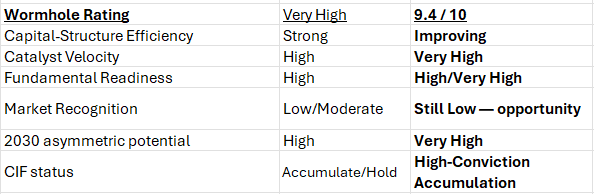
Wormhole Assessment — 9.4/10
FWDI now has several potential nonlinear mechanisms operating simultaneously:
SOL appreciation
× SOL/share growth
× staking compounding
× RWA yield spreads
× ecosystem equity investments
× M&A consolidation
× possible mNAV expansion
× institutional recognition
That multiplication is much more interesting than any one catalyst individually.
This is precisely our WormHole concept: recognition + capital flows + structural change + fundamental execution converging simultaneously.
What could break the thesis?
There are four things I would watch closely.
- SOL itself remains overwhelmingly important. If Solana loses developers, users, institutional adoption or economic activity to competing chains, FWDI’s entire architecture weakens.
- Leverage must remain disciplined. The current ~2.6% cost is excellent. I will become considerably less comfortable if management starts leveraging aggressively to defend SOL/share growth.
- M&A discipline is crucial. Acquisitions must genuinely increase SOL/share. Empire-building would cause an immediate CIF downgrade.
- Fully diluted share count matters more than reported common shares. Our quarterly test should therefore remain brutally simple:
Is SOL per fully diluted share increasing?
If that number stops compounding, we reassess the thesis.
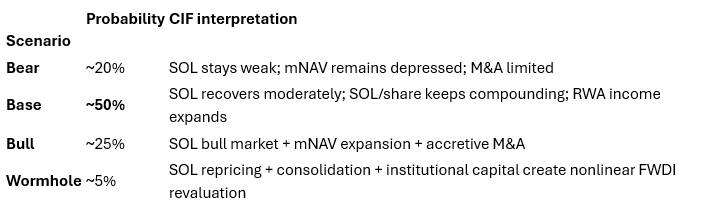
Our 12-Month Scenario Map:
I would not judge Q3 by the $69M GAAP loss.
The more important scoreboard is:
7.0M → 7.55M → 7.81M SOL
and
0.0669 → 0.0730 → 0.0754 SOL/share.
That scoreboard says the strategy is working so far.
FWDI — Post-Q3 2026 Valuation Range
Reference date: August 14, 2026
Current FWDI price: ~$4.10
Method: Probability-weighted scenario analysis; not a price target or assurance.
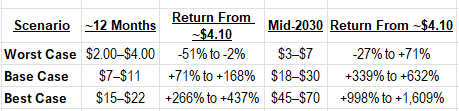
Full CIF / WormHole report provides assumptions and reasoning for the projections above.
Bottom Line
This quarter increases my conviction in FWDI.
Previously, the thesis was largely:
- “The best public-market leveraged vehicle for participating in Solana.”
I would now modify that.
- FWDI is beginning to look like an emerging Solana capital-allocation company — combining treasury ownership, staking infrastructure, cheap financing, RWA investment, ecosystem participation and potentially accretive M&A.
That’s a materially better business model.
For our private LOTM/CIF work, I would therefore keep FWDI in the highest-conviction tier and raise its Wormhole score to approximately 9.4.
More importantly, I would currently rank FWDI above STKE as the higher-quality/probability SOL equity, while STKE may still retain greater percentage upside under an extreme bull/Wormhole scenario.
The next thing I would like us to watch is not the next earnings number. It is whether management executes its first significant accretive acquisition.
If they demonstrate that they can buy discounted digital-asset balance sheets and convert them into higher SOL per FWDI share, the Wormhole thesis moves from theoretical to demonstrated.
General Bearish and Bullish comments about Solana SOL/USD $
Solana (SOL) is currently trading around $76 to $80, sitting significantly down from its late 2025 cyclical double-top peak of roughly $250. YouTube’s crypto narrative for Solana is highly polarized, divided between macro-focused short-term bears calling for a localized bottom and long-term technical bulls eyeing a fundamental trend reversal heading into late 2026.
The Bearish Narrative: Short-Term Pain & Structural Friction
Several data-driven and technical YouTube analysts warn that Solana faces considerable near-term headwinds before any major bull run can resume.
- The $60 Retest & “M-Pattern” Double Top: Technical charts prominently feature a massive double top pattern formed around the $250 mark in late 2025. Channels tracking this “M-shaped” breakdown predict that SOL could see an additional drawdown to structural support zones between $60 and $67 before finding a true cyclical floor.
- Over-Reliance on the Meme Coin Casino: On-chain analysts note that Solana’s massive transaction volume is disproportionately driven by bot activity and speculative trading via protocols like Pump.fun. There is a growing consensus that if meme coin momentum stalls, Solana’s TVL (Total Value Locked) and fee structures risk deeper contraction.
- Token Dilution & Leverage Risks: The rapid expansion of open interest in perpetual futures (climbing as high as $16 billion) indicates heavily leveraged infrastructure. Furthermore, structural inflation (issuing roughly 23 million SOL annually) has triggered governance proposals—such as SGP00002 and SGP00003—aiming to aggressively double the network’s disinflation rate and introduce 14x higher fee burns to protect token value.
The Bullish Narrative: Trillion-Dollar Infrastructure & Upgrades
Conversely, long-term crypto strategists on YouTube claim Solana is building a resilient foundation that shifts the asset from retail speculation to genuine institutional enterprise.
- Dominance in Tokenized Stocks and RWA: Solana has emerged as the premier non-EVM layer-1 network, capturing over 95% of cross-chain tokenized equity volume. Supported by tokenization platforms like Sunrise, trading volume for tokenized traditional equities on Solana expanded six-fold to $4.9 billion in the first half of 2026.
- The Alpenglow Upgrade Catalyst: Slated to roll out through Q3 2026, the milestone Alpenglow Consensus Upgrade will introduce a new “Votor and Rotor” mechanism. This rewrite aims to slash block finality times from several seconds down to a blistering 150 milliseconds, optimizing the network for institutional high-frequency trading.
- ETF-Driven Base Case Assumptions: Institutional investment remains a massive driver. Cumulative net inflows into spot Solana ETFs have scaled past $1.1 billion so far in 2026. Major banking institutions, including Standard Chartered, have updated their targets, projecting SOL to settle between $150 and $250 by late 2026/2027 as it shifts entirely toward real utility, before pacing toward a long-term $2,000 target by 2030.
TOM’s comment: Personally, I tend to anticipate. The current draw down below $4.00 in FWDI price, is an excellent time to be accumulating shares for those with a six month and longer timeline. Tokenization of Everything is a multi-decade process with the initial growth happening now and in an explosive way – though it does not appear in the prices of companies participating – at this time. The building of true wealth is accomplished through the compounding of price and time. $4.00 cost today really means 100% gain on original investment every $4.00 of appreciation. If Tokenization is just beginning and will continue for a decade or more, this is a big opportunity to ride the wave for a long run. This is how we think. It is not for everyone.
This is also a reversal of the decade’s long crypto trend where Retail investing led a reluctant Institutional investment group. Now we have Institutional Investors aggressively investing in the convergence of AI / Crypto / Blockchain / Tokenization movement with the public investors waiting and watching.
This short Vidio interview with Frankin Templeton (BEN) expresses the institutional excitement running through Institutions at this time.
30 Days To Load Up?🚀Franklin Templeton Crypto💰Chris Perkins INTERVIEW
Paul Barron Network published August 13, 2026. 25 minutes.
Good luck and good fortune
With our CTI / DIIF & WormHole profiling, LOTM is able to review and rank any public company based on multiple real world factors with subsets under each of the factor categories. If interested in a free review of your favorite holding or target stock, email us at LOTM.Millions @ gmail.com. We will provide our CIF and WormHole analysis for no cost – one company per request. We will analyze for both a one-year analysis – outlook based of known and possible catalysts and an outlook for the company/stock to 2030. Our conclusion a summarized in a Base Case – Best Case and Worst Case probability outcome. This is our trial period to see how well we can present for the greatest benefit non-professional investors vs simply doing the work for family, self and friends. Remember we are Company Management and the three-year opportunity (hunting for doubles or more) analysis first and leave the fun stuff – trading and timing – to you. Many traders are converted to long term holders, so it is nice to know what you own beforehand.
LOTM Research & Consulting Service
* An account related to LOTM holds a position in this security.
Neither LOTM nor Tom Linzmeier is a Registered Investment Advisor.
Please refer to our web site for full disclosure at www.LivingOffTheMarket.com ZTA Capital Group, Inc.
To Unsubscribe please select “return” and type Unsubscribe in the subject line.
