Strive, Inc. (ASST)
Version 1.1 | Data Cutoff: August 5, 2026 | CIF Research Library
Produced Aug 06, 2026, by LOTM/Tom Linzmeier
Investment Thesis
The bullish thesis is that Strive can use its capital-market architecture and asset-management identity to acquire Bitcoin at an accretive rate while avoiding excessive conventional debt. If management consistently increases BTC per diluted common share, preserves liquidity, and funds SATA economically, ASST could develop into the clearest public alternative to Strategy.
The central analytical question is not how much Bitcoin Strive owns. It is whether each financing transaction increases the long-term economic claim on Bitcoin for the common shareholder after accounting for dilution, preferred claims, dividends, warrants, operating costs, and taxes.
Three Dominant Value Drivers
• Bitcoin-per-share growth: Treasury holdings rose from approximately 7,627 BTC at year-end 2025 to 20,000 BTC by July 24, 2026. The pace demonstrates unusually strong access to capital and transaction execution.
• Perpetual-preferred financing: SATA gives Strive a potentially repeatable source of long-duration capital without a fixed maturity. If issued near or above par and supported through market cycles, it can finance Bitcoin accumulation with less refinancing risk than conventional debt.
• Alpha through M&A and asset management: The Semler acquisition added 5,048 BTC and operating assets. Strive also manages investment products, creating a possible operating ecosystem around the treasury rather than functioning solely as a passive Bitcoin holding company.
Three Biggest Risks
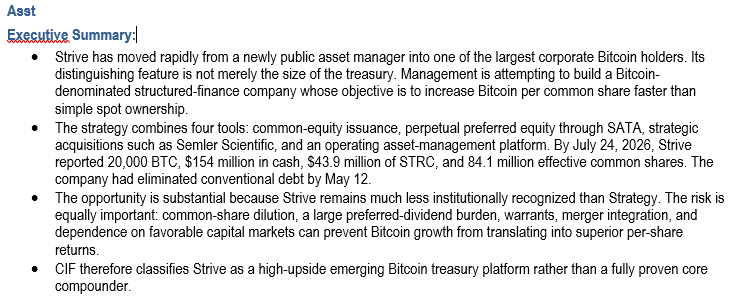
• Dilution and capital-structure complexity: Effective common shares reached 84.1 million by July 24, while 26.6 million additional shares remained underlying traditional warrants. A rising Bitcoin treasury can still produce poor common-share economics if fully diluted shares rise faster.
• Preferred-dividend obligation: SATA carried a 13.0% annualized dividend rate. The perpetual structure removes maturity pressure but creates a high recurring cost that must be supported through cash, capital markets, or asset monetization.
• Bitcoin and market-access dependence: The model works best when ASST or SATA can be issued at attractive valuations. A prolonged Bitcoin decline, common-stock discount to NAV, or preferred-price weakness could close the financing window at the wrong time.
Management Assessment
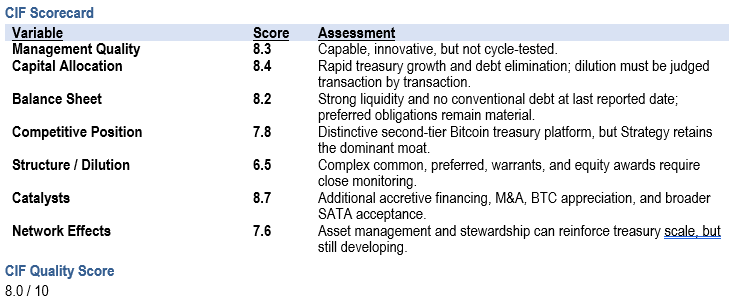
CEO Matthew Cole and CIO Ben Werkman have shown ambition, creativity, and speed. Management completed the public-company combination, raised large amounts of capital, acquired Semler Scientific, retired conventional debt, expanded Bitcoin holdings, and launched a differentiated preferred-security structure in a short period.
The positive conclusion is that this is a capable capital-markets team with a clearly articulated Bitcoin-per-share objective. The caution is that the record is still brief. The team has not yet demonstrated how SATA performs through a sustained bear market, how effectively Semler is integrated, or whether repeated issuance will remain accretive across a full cycle.
CIF Management Assessment: 8.3/10 – strong early execution, but not yet cycle-tested.
Capital Allocation
Strive explicitly describes open-market Bitcoin purchases and capital raises as beta initiatives, while seeking alpha through acquisitions or other transactions that obtain Bitcoin at a discount to market value. The Semler transaction is the first major proof point for the alpha strategy.
Capital allocation has improved structurally through the elimination of conventional debt and the retention of substantial liquidity. The $50 million STRC investment also provides yield and a liquid reserve, although it introduces exposure to another Bitcoin treasury security rather than cash-like certainty.
The most important future KPI is BTC per assumed fully diluted common share after all preferred obligations. Total BTC growth alone is insufficient.
Balance Sheet and Capital Structure
As of July 24, Strive reported 20,000 BTC, $154.0 million of cash, and STRC valued at $43.9 million. As of May 12, the company reported no short- or long-term debt. This is a materially stronger conventional debt position than many leveraged treasury companies.
However, the balance sheet is not unencumbered in an economic sense. SATA is perpetual preferred equity ahead of the common stock, and its dividend rate is high. The preferred does not create a maturity wall, but it creates an ongoing senior claim on distributable resources. Common shareholders must also monitor ATM issuance, employee awards, and the large traditional-warrant overhang.
CIF Balance Sheet Assessment: strong liquidity and low conventional debt; moderate-to-high structural complexity.
Ecosystem Analysis and Network Effects
Strive is building an ecosystem around Bitcoin treasury management, public-market financing, asset management, and Bitcoin stewardship. Its support for Brink and the Bitcoin Policy Institute strengthens its identity as an active Bitcoin institution rather than a passive holder.
Potential network effects arise if SATA becomes a recognized treasury and income product, ASST becomes a liquid institutional Bitcoin vehicle, and Strive Asset Management attracts assets because of the company’s Bitcoin expertise. Each component could reinforce the others: asset-management credibility supports capital access; capital access supports Bitcoin-per-share growth; treasury scale supports brand recognition.
These network effects remain developing rather than proven. Strategy still has far greater liquidity, brand recognition, and depth of capital-market.
Institutional Intelligence and Wall Street View
Institutional recognition is increasing because Strive has become a top-tier corporate Bitcoin holder and has introduced a distinctive perpetual-preferred structure. Nevertheless, Wall Street coverage and investor familiarity remain limited compared with Strategy.
The market is likely to focus on four measurements: BTC per diluted share, common-stock premium or discount to adjusted NAV, SATA trading stability and dividend coverage, and the pace of common-share issuance. Successful execution could close part of the recognition gap; disappointing per-share results could cause the market to value ASST as an expensive financing vehicle rather than a compounder.
Institutional Recognition Gap (IRG™)
High
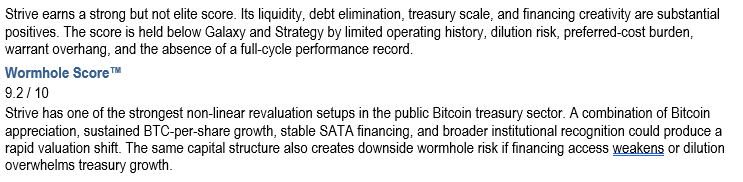
Strive has achieved treasury scale far faster than institutional recognition. The market has not yet decided whether the company is a durable Bitcoin-per-share compounder or a highly promotional financing structure. That uncertainty creates the recognition gap and explains both the opportunity and the volatility.
Stage Analysis
Anticipatory View: Emerging Stage 2 candidate. The fundamental platform is expanding rapidly, and the stock offers strong upside sensitivity to Bitcoin and capital-market execution.
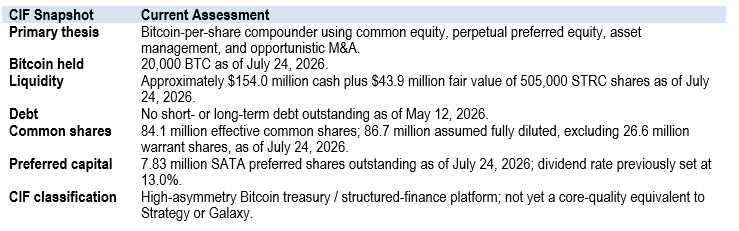
Strict Technical View: Volatile and not yet mature enough to treat as a stable Stage 2 compounder without confirmation from the 30-week moving average, relative strength, and volume pattern. At approximately $12.40 on August 5, 2026, position sizing should reflect treasury-stock volatility rather than operating-company stability.
CIF Action Bias: Accumulate selectively on weakness only when the adjusted NAV, capital structure, and Bitcoin-per-share trend are favorable. Do not evaluate ASST solely from the headline BTC total.
Why We Could Be Wrong
• SATA may trade below par or require an uneconomically high dividend, limiting future issuance and increasing cash demands.
• Common and preferred issuance may grow faster than the economic value created for common shareholders.
• The Semler acquisition may add operating complexity without producing meaningful alpha beyond acquired Bitcoin.
• Bitcoin could experience a prolonged decline that reduces NAV, weakens financing access, and increases investor concern about dividend sustainability.
• Warrant exercises, stock awards, or additional acquisitions could materially increase the fully diluted share count.
• The asset-management business may remain too small to offset corporate overhead and preferred costs.
2030 Outlook
Best Case: Strive becomes the second major institutional Bitcoin treasury platform after Strategy, SATA develops into a durable preferred-capital franchise, asset management grows, and BTC per diluted common share compounds. In this case, ASST could deliver high-multiple appreciation and graduate toward core-compounder status.
Base Case: Strive remains a credible but more volatile Bitcoin treasury alternative. Bitcoin holdings grow, but recurring dilution and preferred costs absorb part of the benefit. The stock outperforms during strong Bitcoin cycles but remains dependent on capital-market conditions.
Worst Case: The financing premium disappears, SATA becomes expensive or difficult to issue, common dilution accelerates, and Bitcoin declines. Strive retains a large treasury but common shareholders receive less economic participation than the headline BTC balance suggests.
CIF 2030 Performance Estimate: approximately 3x-8x in the successful base-to-best-case range, with materially greater downside risk than Galaxy or Strategy. This is a scenario estimate, not a price target.
Portfolio Classification and Final Conclusion
Classification: High-Conviction Satellite / Wormhole Opportunity
Strive should not yet replace Strategy as the benchmark Bitcoin treasury holding. It may, however, deserve a smaller satellite position for investors seeking greater asymmetry and willing to monitor capital structure closely.
The central conclusion is constructive: Strive has built real scale, eliminated conventional debt, preserved liquidity, and demonstrated unusual financing creativity. The central caution is equally clear: future success must be measured in Bitcoin and net asset value per fully diluted common share after SATA and all other senior claims—not by total Bitcoin ownership alone.
CIF Current Rank: Higher asymmetric potential than Strategy; lower quality, durability, and probability of success. The company can graduate if it proves accretive per-share execution through a full Bitcoin cycle.
Primary Sources and Data Notes
• Strive Form 8-K filed July 27, 2026: 20,000 BTC, cash, STRC holdings, common shares, SATA shares, warrants, and fully diluted share information.
• Strive Form 10-Q for quarter ended March 31, 2026, filed May 14, 2026: operating segments, treasury strategy, debt elimination, ATM issuance, preferred structure, and subsequent events.
• Strive Form 10-K for year ended December 31, 2025, filed March 19, 2026: merger history, treasury acquisition costs, warrants, share issuance, asset-management strategy, and risk disclosures.
• Strive investor-relations release dated July 22, 2026: Bitcoin Stewardship Commitment and initial support for Brink.
• Market price reference: ASST approximately $12.40 at 1:25 p.m. Central Time on August 5, 2026.
Important: This report is investment research and scenario analysis, not individualized investment advice. Digital asset treasury securities can experience extreme volatility, dilution, liquidity changes, and rapid premium/discount shifts.