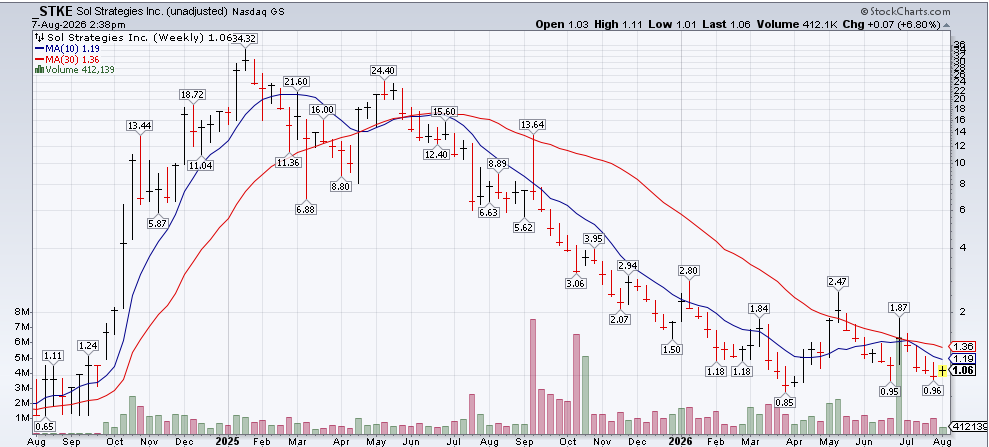
SOL Strategies (STKE) $1.06
A conversation between Chat & Me
Written Aug 07, 2026, by LOTM/Tim Linzmeier and screened through our LOTM proprietary CIF/DIIF/WormHole system.
Bonus:
- LOTM/CIF “WormHole” ranking between STKE, FWDI, SBET, FIGR, SECZ & HYPD
- Update of the new Gold rumor.
Hi Chat – I am looking at SOL Strategies (STKE*) $1.06, its online shares outstanding and market cap.
1) What is the outlook for post-merger acquisition it has in motion as to share count and market cap, “if” the deal is completed at today’s prices. 2) What is our CIF projection for a price revaluation post the merger being completed?
Sol Strategies Inc. (STKE) $1.06 Finviz.om Chart / News / Stats for STKE
Chat: I dug into STKE because I think the share-count question is particularly important here. There is also one distinction worth making: the Houdini Swap acquisition you are referring to has already closed, on June 1/2. So today we can analyze the actual post-Houdini capitalization rather than estimating what it might become.
At roughly $1.06 today, STKE is still an unusually small public company relative to what management is trying to assemble.
Where the share count stands
The most recent market data I find shows approximately 34.69 million shares outstanding, versus roughly 25 million a year earlier. At $1.06, that implies an equity market capitalization of only about:
34.69M × $1.06 ≈ $36.8 million.
Some services use a larger current-share-class figure of about 37.5M, which would put market capitalization closer to $40M. I would therefore think of STKE today as approximately a $37–40 million equity valuation, rather than attach too much significance to the exact number.
The Houdini transaction itself added 2,812,301 shares at closing. STKE paid $7M cash initially, $4M in stock, owes another $5.75M cash December 1, plus a $1.25M holdback. There is also a potential $10M two-year earn-out, but importantly that earn-out is tied to EBITDA performance rather than being an automatic share issuance.
There is one additional dilution item I would keep on our CIF radar: the older Cogent transaction requires future share issuances through November 2027. The scheduled installments are roughly 387,000 shares each, subject to adjustments based on delegated SOL.
So, for our purposes, I would model STKE’s near-term normalized basic share count around 35–38M, rather than assuming some huge merger-related jump to 60M or 100M shares.
And that is actually important to the Wormhole thesis.
What STKE now owns is much more interesting than the market cap suggests
The Houdini transaction changes the nature of the company.
Houdini produced approximately $13M of revenue in 2025, processed approximately $2.5B of cumulative swap volume, and has integrations with 32 exchange partners.
Yet the entire combined STKE company is being valued at only around $37–40M of equity value.
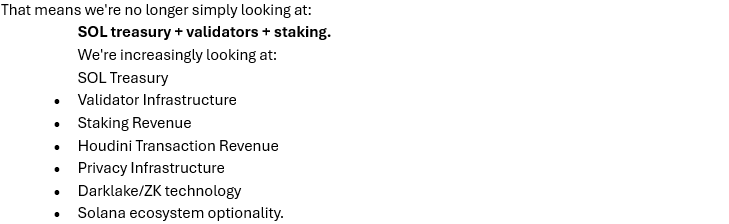
That is exactly the evolution we’ve been looking for in our DAT work: move from “owns the token” toward “owns businesses built around the token.”
My post-acquisition valuation framework
Rather than predicting a single price, I’d use three recognition levels:
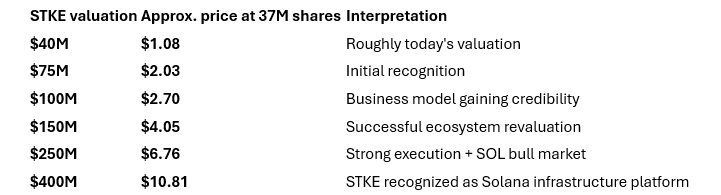
I don’t believe the $250–400M outcomes should be considered the base case today. But I do think $100–150M is a defensible intermediate revaluation zone if management demonstrates that Houdini’s revenue is durable and can grow within the broader STKE ecosystem.
That produces approximately $2.70–$4.05 per share, or roughly 2.5–4× today’s stock price.
Where I would put our probabilities
My rough 12–24 month CIF framework would be:
- Bear case — $0.70–$1.25: SOL weakness, Houdini revenue deteriorates, continued dilution/capital requirements, little institutional recognition.
- Base case — $2.50–$4.00: Houdini revenue proves reasonably durable, validators/staking continue expanding, privacy products develop, and investors begin valuing STKE as an operating Solana infrastructure company rather than essentially a small DAT.
- Bull case — $6–$10: SOL enters another strong expansion cycle, Houdini grows materially, STKE demonstrates cross-selling/network effects among its assets, and the market assigns an infrastructure/platform multiple.
- Wormhole case — $10+: This requires something more than simply SOL appreciating. STKE would have to establish itself as one of the recognizable publicly traded Solana infrastructure/ecosystem companies.
And this last distinction is important.
Why I think STKE is becoming more interesting
The original STKE thesis had a weakness: why own STKE instead of simply owning SOL?
That question is becoming easier to answer.
Houdini generated about $13M of 2025 revenue. STKE acquired it for an announced $18M purchase price. That’s approximately 1.4× trailing revenue for an asset operating in crypto transaction infrastructure.
If management can grow Houdini while integrating Darklake/privacy technology and its validator operation, STKE starts looking less like a treasury wrapper and more like a small Solana financial-infrastructure holding company.
That deserves a different valuation methodology.
And there is another detail I like: STKE financed the initial Houdini cash component through DeFi protocols using its balance sheet without selling its treasury SOL. That is exactly the kind of capital-allocation behavior we want to watch under CIF.
My current CIF interpretation
- I would move STKE slightly up, not down, following the transaction.
The share dilution is real, but it bought an operating revenue-producing business rather than simply financing corporate overhead or buying SOL at market prices. That is productive dilution, provided Houdini performs.
- At ~$1.06 and roughly a $40M equity capitalization, the market doesn’t appear to be assigning much value yet to the possibility that STKE becomes an integrated Solana infrastructure company.
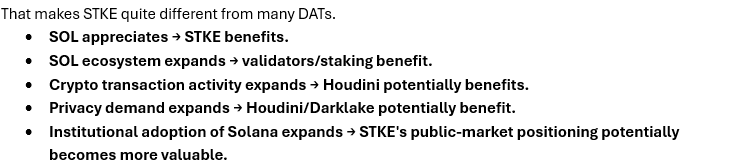
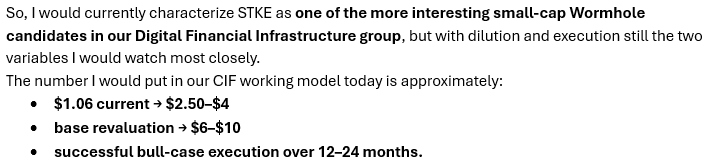
The key isn’t the merger closing anymore. The next Wormhole trigger is evidence that the pieces STKE has assembled are beginning to reinforce one another. That would be the point where I think the market-cap discussion changes dramatically.
Tom: For my (Tom’s) Perspective – of the symbols that follow, Rank them for our LOTM/CIF / WormHole potential for 1) Base Case – 2) Worst case and 3) Best case. STKE, FIGR, SBET, FWDI, HYPD, SECZ
Chat: Yes. I would rank these differently depending on whether we are asking “highest-quality – expected outcome” or “largest Wormhole.”
That distinction matters a great deal with these six.
I updated the comparison against current developments. In particular, Figure is showing substantial operating growth, Securitize is now actually public as SECZ, and Forward Technology (FWDI) has continued building the largest public-company SOL treasury.
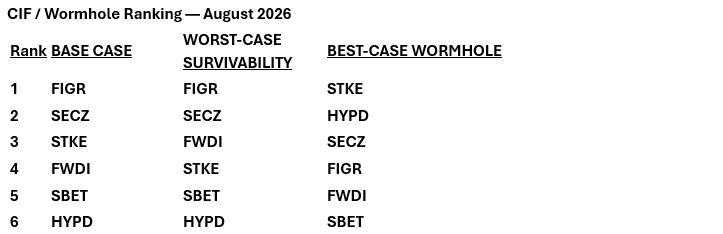
There is a very interesting story underneath those rankings.
1. FIGR — Best risk-adjusted company
Base Case: #1 | Worst Case: #1 | Best Case: #4
FIGR is the one I would be most comfortable calling an exceptional company rather than simply an exceptional speculation.
Figure’s Q1 consumer-loan marketplace volume grew 113% YoY, it added 80 partners, and YLDS and Democratized Prime activity each grew about 80% sequentially. More than 240 partners now use its ecosystem, and Figure says it has originated more than $21 billion of home equity.
That gives FIGR something the smaller names don’t have:
Existing business + revenue + institutional adoption + blockchain rails + tokenization + network effects.
Its weakness for Wormhole purposes is actually its strength: the market already knows it’s good.
CIF conclusion: Highest probability compounder of the six.
2. SECZ — Possibly the most important digital asset infrastructure company
Base: #2 | Worst: #2 | Best: #3
This one has risen materially in my thinking.
Securitize has now completed its public listing, has more than $4 billion of assets brought on-chain, and its institutional relationships include BlackRock, Apollo, KKR, VanEck and others. It also has relationships/infrastructure initiatives involving NYSE and Computershare.
This is exactly our CIF question:
Does this company become more valuable as the entire ecosystem grows regardless of which individual application wins?
For SECZ, my answer is increasingly yes.
If tokenization becomes a major capital-markets architecture, SECZ doesn’t need to predict whether Ethereum, Solana, Avalanche or another chain ultimately dominates.
It provides infrastructure.
CIF conclusion: Potential picks-and-shovels winner of tokenization.
3. STKE — My #1 Wormhole
Base: #3 | Worst: #4 | Best: #1
Our previous discussion actually strengthened my conviction here.
The reason is starting size.
STKE doesn’t have to become FIGR or Securitize to produce an extraordinary percentage return. It merely has to become a credible, profitable Solana infrastructure company.
Houdini gives it something enormously important:
Treasury → validator → staking → transactions → privacy → operating revenue.
That’s the transition we’ve been looking for from DAT to ecosystem business.
At STKE’s tiny starting valuation, successful execution can change the valuation methodology itself.
That’s almost the textbook definition of our Wormhole Factor:
Business changes first → market continues using old valuation → recognition suddenly catches up.
CIF conclusion: Highest asymmetric revaluation candidate.
4. HYPD — Highest-risk/highest-torque ecosystem bet
Base: #6 | Worst: #6 | Best: #2
This ranking might initially surprise you.
HYPD has a much weaker base-case probability than FIGR/SECZ/STKE, but its best-case outcome is enormous.
Why?
Because Hyperliquid itself is the variable.
If HYPE/Hyperliquid becomes one of the dominant financial protocols in crypto, HYPD has an opportunity to evolve from a small HYPE treasury vehicle into a public-market Hyperliquid ecosystem company.
That’s potentially explosive.
But it is also much more dependent upon:
Hyperliquid winning + management executing + capital markets remaining available + dilution being controlled.
So HYPD produces the widest distribution of outcomes.
CIF conclusion: Classic Johnny Appleseed/Wormhole candidate—not the highest-quality core holding.
5. FWDI — Strong asset backing + elite sponsorship
Base: #4 | Worst: #3 | Best: #5
FWDI is different.
It now owns more than 7.5 million SOL and has built the largest public corporate SOL treasury. It also has Galaxy Digital, Jump Crypto and Multicoin behind the original $1.65 billion treasury financing.
That is formidable.
And FWDI is doing more than sitting on SOL: validator infrastructure, fwd SOL, protocol investments and liquidity provision all move it toward ecosystem participation.
But its huge SOL position creates an interesting CIF problem.
It simultaneously provides asset backing and reduces the degree to which the company is an undiscovered operating company.
Therefore, I see FWDI as:
Better downside structure than HYPD/STKE, but less pure Wormhole asymmetry.
6. SBET — Good vehicle, but the thesis is more replicable
Base: #5 | Worst: #5 | Best: #6
I don’t dislike SBET.
SharpLink has evolved into an institutional ETH treasury platform emphasizing staking, protocol rewards and yield generation.
The problem is relative to these other five.
Ask our CIF question:
What does SBET uniquely own that becomes substantially more valuable as Ethereum succeeds?
The answer isn’t as strong.
ETH treasury? Replicable.
ETH staking? Replicable.
Institutional custody? Replicable.
Contrast that with:
- FIGR — blockchain-native lending marketplace
- SECZ — regulated tokenization infrastructure
- STKE — integrated SOL/validator/privacy/transaction ecosystem
- HYPD — early public Hyperliquid ecosystem positioning
- FWDI — enormous SOL treasury + Galaxy/Jump/Multicoin ecosystem
That pushes SBET down this particular list even though it could still perform extremely well if ETH appreciates substantially.
The ranking I think matters most for our process
If I combine CIF company quality + downside + Wormhole + probability of recognition, rather than simply ranking potential upside, my overall ranking is:
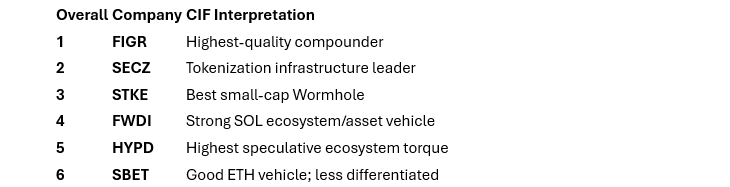
But I wouldn’t necessarily allocate capital in those proportions.
I see three different jobs emerging.
FIGR + SECZ = Quality/Infrastructure. These are the companies I’d most want to still own if crypto enthusiasm cools, but blockchain financial infrastructure keeps developing.
STKE + HYPD = Wormholes. Small starting valuations plus the possibility that the nature of the company itself changes. These are where a modest amount of capital can potentially produce an outsized portfolio result.
FWDI + SBET = Asset/Ecosystem Leverage. These give leveraged/reflexive exposure to SOL and ETH respectively, but the underlying crypto asset remains a larger part of the investment thesis.
And that leads me to one refinement of CIF that I think we’ve gradually discovered through this work:
The highest-quality company and the highest-potential investment are not necessarily the same company.
FIGR is my highest-confidence company.
STKE is my highest Wormhole.
HYPD is my highest speculative torque.
SECZ may have the largest ultimate addressable market.
Those four distinctions are much more useful to me than forcing all six companies into one linear 1–6 ranking.
TOM: Excellent. Thank you
Chat: You’re very welcome. This six-company comparison is especially useful because it separates business quality, survivability, and Wormhole asymmetry rather than confusing them as one measure.
I think that distinction will improve CIF going forward: FIGR can be the better company while STKE can simultaneously be the better asymmetric opportunity. That’s exactly the kind of separation we want the framework to identify.
GOLD:
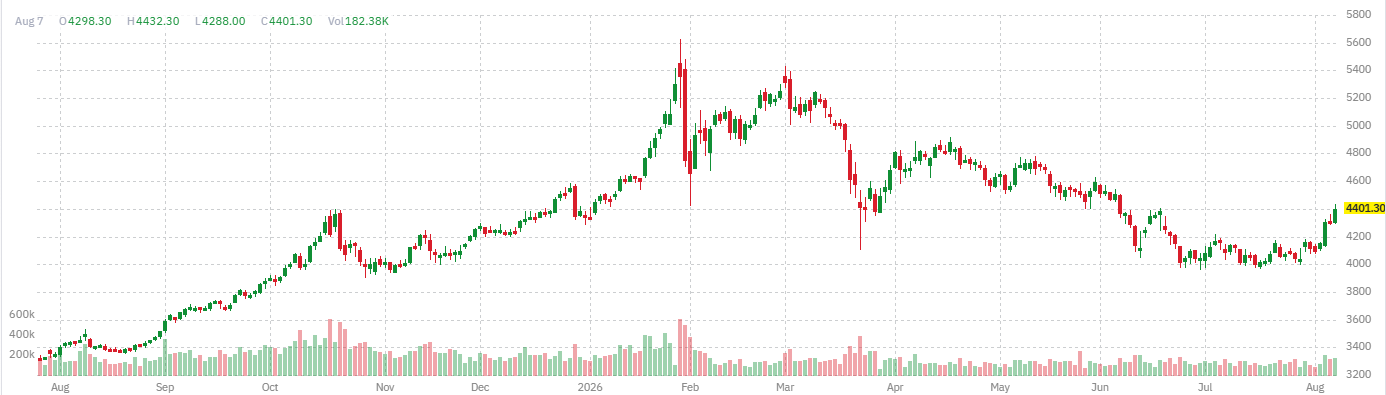
TOM: Total change of subject: Is there rumors involving gold or silver and a monetary reset that is a new rumor swirling around
Chat: Yes. I checked because there is a fresh version of the “monetary reset” story circulating, particularly in precious-metals circles. My conclusion is that it contains a real structural development surrounded by a much more speculative reset narrative.
The new rumor seems to combine several ideas: that the U.S. could revalue its official gold holdings dramatically upward from the statutory book price; that gold could consequently be used to strengthen the sovereign balance sheet or support a redesigned monetary architecture; that BRICS countries are developing alternatives to dollar settlement; and, in the more aggressive versions, that gold—and sometimes silver—would suddenly be repriced much higher as part of a coordinated monetary reset. I found a piece published just six days ago specifically circulating a U.S. Treasury gold-certificate revaluation scenario, so you are picking up on something that really has become active again recently.
What is real underneath the rumor
There is a significant monetary development occurring, but I would call it a gradual reserve-system rebalancing rather than a secret overnight reset.
Central banks have accumulated an average of roughly 1,000 tonnes of gold annually over the past four years, versus about 500 tonnes annually during the preceding decade. In the World Gold Council’s new 2026 survey, 89% of reserve managers expect global central-bank gold reserves to increase over the next year, and a record 45% expect their own institution to increase its gold holdings.
That’s significant.
And the buying continues: reported central-bank reserves increased by a net 41 tonnes in May, including purchases by China, Poland, Uzbekistan, Kazakhstan and Singapore.
Meanwhile, BRICS really is working on alternatives to dollar-centric payment infrastructure. Reuters reported just last month that even Jim O’Neill—the economist who coined “BRIC” and was previously skeptical—now considers development of alternatives to the dollar increasingly realistic, although the dollar remains dominant.
So, there is a genuine trend:
Dollar-dominated reserves → more diversified reserves → more gold → alternative settlement systems.
That’s real.
Where the rumor gets ahead of the evidence
I cannot find credible evidence of an imminent coordinated monetary reset in which governments suddenly declare gold at $10,000, $20,000, etc., or formally remonetize silver.
Nor do I find credible evidence that BRICS has decided to introduce a silver-backed currency. In fact, one of the viral claims circulating this year—that BRICS had officially backed a currency with silver—was itself subsequently debunked.
Silver is particularly important to separate from gold here.
Gold has an official monetary/reserve role. Silver largely doesn’t.
Central banks hold enormous quantities of gold as reserves. They generally don’t hold silver as monetary reserves.
Therefore, if there really were some eventual monetary reorganizations involving hard assets, gold is far more likely to participate directly.
Silver would benefit indirectly, potentially very powerfully, through investor flows, monetary-metal psychology and the gold/silver relationship.
But there is something here that interests me for CIF
This actually connects extremely well with our Wormhole concept.
Suppose there is no dramatic monetary reset whatsoever.
Instead, over five or ten years:
central banks steadily reduce their reliance on sovereign bonds; gold’s percentage of reserves increases; BRICS nations build alternative settlement rails; governments become more comfortable settling bilateral trade outside the dollar; and Western investors gradually recognize gold again as a strategic monetary asset.
You don’t need a reset.
The repricing itself becomes the reset.
And the World Gold Council’s 2026 survey is quite striking on this point: 84% of responding central banks believe gold will represent a moderately or significantly larger share of global reserves five years from now.
That is much more important to me than YouTube predictions of an overnight $20,000 gold price.
And this could matter enormously for our miners
This is where my ears perk up for our CIF work.
If gold were simply to move substantially higher over several years—not because of an announced reset but because the global monetary system progressively assigns more value to gold—the operational leverage in quality miners and royalty companies could become enormous.
A miner producing gold at, say, $1,700–$2,000 all-in costs doesn’t experience a 50% increase in profit when gold rises 50%. Its margin can increase multiples.
Then something else happens:
Gold rises → margins explode → free cash flow rises → balance sheets improve → dividends/buybacks increase → generalist investors return → valuation multiples expand.
That’s two layers of leverage: earnings leverage followed by multiple expansion.
Silver miners potentially have even greater torque because silver has the additional industrial scarcity/electrification component.
So, I would not invest based upon the “monetary reset” rumor.
But I would take the underlying evidence seriously. In fact, I think it reinforces something we’ve already been doing – keeping gold/silver/miners as the counterweight to our crypto/blockchain exposure makes increasing strategic sense.
There may even be a CIF question buried in this that is worth exploring separately:
If gold is gradually being remonetized by central banks rather than officially “reset,” which of our gold/silver companies has the greatest Wormhole leverage to that change?
That screen could produce a rather different ranking from simply asking which are the best mining companies.