
The major Benefit of Blockchain and Tokenizing physical assets is that it can increase the security aspect of ownership while eliminating the cost of Middle-men.
Difference between owning Tokeneized Physical Gold Vs a Gold ETF or owning and storing Physical Gold.
➢Tokenized Gold generates a Yield paid in physical gold.\
Yield is generated from the leasing of gold (See Below)
➢Owning a Gold ETF or Physical Gold creats a cost based system for the gold owner.
Costs are incurred for insurance, storage and marketing. This is a drag on gols performance. (See Below)
Streamex Corp (NASDAQ: STEX) utilizes multiple approved custodians for its physical gold-backed security, GLDY, including: [1, 2]
For the vaulting of its own physical allocated gold, the company has indicated it works with a tier-one bullion bank in the United States. [1]
Key Operational Partners
- Gold Yield Partner: Monetary Metals acts as the exclusive partner for leasing the underlying gold to generate a target annualized yield of up to 4%.
- Auditor & Attestation: EisnerAmper serves as the auditor and physical gold attestation provider for the fund.
- Fund Administrator: Zedra manages the daily administration of the fund.
- Proof of Reserves: Streamex integrates with Chainlink Proof of Reserves to provide transparent, on-chain verification of the physical gold backing. [1, 2, 3, 4]
Streamex is structured as a vertically integrated commodity tokenization company that maintains a gold-denominated balance sheet, using the majority of its capital raises to purchase physical bullion.
Regarding the yield and redemption processes for STEX’s GLDY security, here is the breakdown of how the tokenized gold operates:
1. Yield-Generation Process
Unlike traditional Gold ETFs (like GLD), which charge a management fee that slowly “eats” your gold, GLDY is designed to pay a yield in gold.
- The Mechanism: Streamex partners with Monetary Metals to participate in the “Gold Yield Marketplace.”
- Leasing: The physical gold held by the fund is leased to high-quality commercial users of gold—such as jewelers, refiners, or manufacturers—who use it for their working inventory.
- The Payout: These businesses pay a lease fee in gold. This allows STEX to target a 3% to 4% annualized yield, which is paid out to GLDY holders by increasing their gold balance or providing additional tokens.
- Risk Mitigation: The leases are typically senior-secured and backed by the inventory of the commercial users, rather than being “paper gold” or derivatives.
2. Redemption Terms
GLDY offers two primary ways to exit or “redeem” your position:
- Secondary Market Liquidty: Since GLDY is tokenized and trades on the tZERO ATS (Alternative Trading System) and is supported by Coinbase Prime, you can sell your tokens for cash (USD/USDC) during market hours.
- Physical Redemption: One of the core features of STEX is the “Redeemability” of the underlying asset.
- Minimums: There are typically minimum ounce requirements (often starting at 10oz or 1kg) to trigger a physical withdrawal.
- Logistics: Upon a valid redemption request and the burning of the equivalent tokens, Streamex coordinates the delivery of the physical bullion from their vaulting partners directly to the investor via secure courier.
- Fees: Physical redemptions usually incur a processing and shipping fee, which is deducted from the total value or paid separately.
3. Transparency
Because GLDY uses Chainlink Proof of Reserves, you can verify the ratio of tokens in circulation versus the physical bars held in the vault in near real-time on the blockchain.
The primary difference between GLDY and a standard Gold ETF is the direction of the “cash flow.” While standard ETFs act as a cost center (charging you to hold the metal), GLDY acts as a yield-bearing asset.

*Note: STEX typically generates its revenue from the spread in the leasing process rather than a direct management fee on holders.
The Net Difference
If gold prices remain flat ($0% price change) over one year:
- In a Standard ETF (GLD): You would lose approximately $40 for every $10,000 invested due to the expense ratio. Over time, this leads to “share decay,” where each share represents slightly less gold.
- In GLDY: You would gain approximately $300 to $400 for every $10,000 invested (paid in additional gold). Your holdings grow in physical weight even if the market price of gold doesn’t move.
Why the difference exists
Standard ETFs like the SPDR Gold Shares are “passive” and incur costs for storage, insurance, and marketing. STEX uses an “active” strategy by partnering with Monetary Metals to lease the gold out, turning a storage cost into a productive lease.
When you compare compounding over a decade, the “fee vs. yield” gap creates a massive difference in how much physical gold you actually own.
The following projection assumes a starting investment of $10,000 and a flat gold price to isolate the impact of fees versus yield.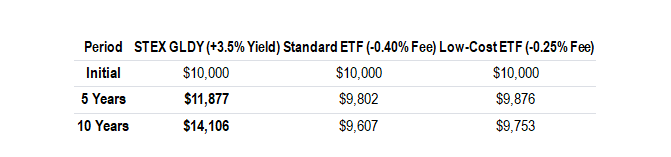 Key Takeaways
- The “Yield Gap”: After 10 years, a GLDY investor would have roughly 46% more value (and 46% more physical gold weight) than an investor in a standard ETF like GLD, assuming gold prices are identical.
- Share Decay: In traditional ETFs, your “gold ounces per share” decreases every year as the fund sells gold to pay the expense ratio. In GLDY, your “ounces per token” increases as the yield is paid out.
- Market Growth: If the spot price of gold rises, this compounding effect is amplified because you are earning 3.5% more of an increasingly valuable asset. For context, over the last 10 years, gold itself has seen an annualized return of ~13.1%.
Streamex Corp (STEX) does not lease gold directly to end-users; instead, it uses Monetary Metals as its exclusive gold yield partner to manage the leasing process. [1, 2]
Monetary Metals leases this physical gold to “gold-using” businesses that require it for their daily operations.
These lessees typically include: [1, 2]
- Jewelry Manufacturers & Retailers: Businesses that need gold for work-in-progress inventory without taking on the price risk of buying it outright. Examples of past partners include GoldSilver.com and major retailers in the UAE.
- Refineries & Mints: Entities that use gold as raw material for processing and production. Partner examples include the Istanbul Gold Refinery (IGR) and European refiner L’Orfebre.
- Industrial Fabricators: Companies like Pietro Galliani Brazing S.p.A. that use precious metals in industrial manufacturing.
- Specialized Financial Firms: Institutional counterparties like Quantum Metal or Valaurum (makers of Aurum® gold currency) that utilize physical gold for their own specialized financial products. [1, 2, 3, 4, 5]
How the Lease Works
- Purpose: These businesses lease the gold to avoid the high cost of financing a physical inventory in fiat currency and to eliminate the need for expensive hedging.
- Ownership: Streamex (via the GLDY SPV) retains full legal title to the physical gold at all times.
- Security: Lessees are typically required to maintain insurance on the metal, and Monetary Metals performs due diligence on their financial health to mitigate default risk. [1, 2, 3, 4, 5]
To protect the physical gold while it is out on lease and earning that 3.5% yield, Monetary Metals (STEX’s partner) uses a “belt and suspenders” approach to risk management.
Because you aren’t just holding gold in a vault, but are instead putting it to work, they employ these four primary safeguards:
1. Senior Secured Status
The gold is leased to companies (like refiners or jewelers) as a senior-secured obligation. This means in the event of a business failure, the gold owners (STEX/GLDY holders) are at the front of the line to be paid back. The gold is treated as “bailment,” meaning the lessee uses it but never actually owns it.
2. Comprehensive Insurance
Every business that leases the gold is required to carry all-risk insurance that specifically covers the gold while it is on their premises or in transit. This protects against:
- Theft or robbery.
- Natural disasters (fire, flood, etc.).
- Damage during the manufacturing process.
3. Strict Counterparty Due Diligence
Monetary Metals acts as the “credit officer.” They only lease to businesses with:
- Proven Track Records: Most lessees are established industrial players (like the Istanbul Gold Refinery or European fabricators).
- Asset-Heavy Balance Sheets: They target companies that have significant physical assets that can serve as collateral.
- No Price Speculation: Lessees must prove they are using the gold for operations, not gambling on the price of gold, which reduces the risk of a “blow-up.”
4. Continuous Monitoring & Auditing
The gold doesn’t just disappear into a black hole. The protection includes:
- Physical Inspections: Monetary Metals and third-party auditors conduct on-site inspections of the lessees’ facilities.
- Inventory Reporting: Lessees must provide regular reports confirming the gold is present in their work-in-progress (WIP) or finished goods.
- Chainlink Proof of Reserves: On the STEX side, the total value of the gold (both in-vault and on-lease) is monitored via Chainlink to ensure the GLDY tokens remain fully backed at all times.
The Bottom Line: While there is technically more risk than “sitting in a hole in the ground,” these measures are designed to make the risk comparable to a high-grade corporate bond, but paid in physical gold.
LOTM Research & Consulting Service
* An account related to LOTM holds a position in this security.
Neither LOTM nor Tom Linzmeier is a Registered Investment Advisor.
Please refer to our web site for full disclosure at www.LivingOffTheMarket.com ZTA Capital Group, Inc.
To Unsubscribe please select “return” and type Unsubscribe in the subject line.
