
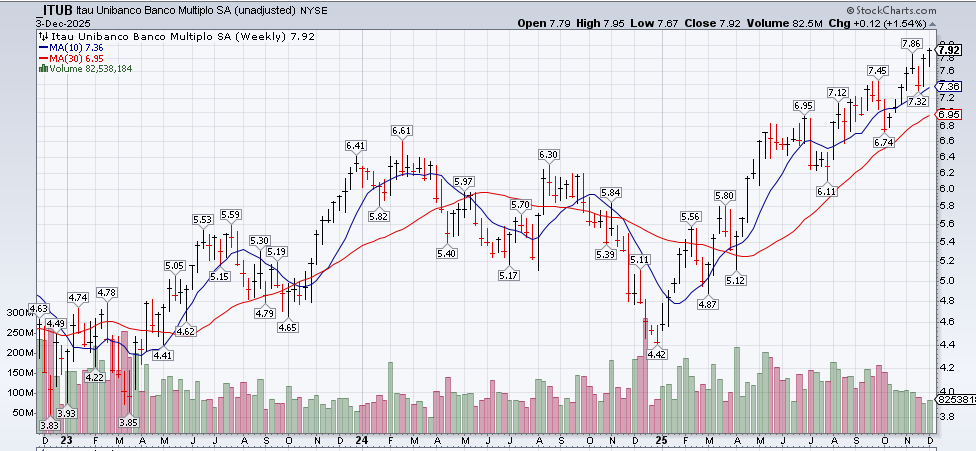
 Three-year weekly chart
LOTM is adding Itaú Unibanco Holding S.A. ADR (ITUB*) as a
- High dividend (but irregular) distribution policy
- As a large innovative leader in Banking, Crypto and Blockchain practice operating outside the USA
- The shares have buy now and accumulate on weakness optionality.
- ITUB is marginable, has liquid tradability and trades on the New York Stock Exchange
Owning Itaú Unibanco Holding S.A. ADR (ITUB) for the next year presents a mix of strong company fundamentals and significant macroeconomic/political risks inherent to investing in Brazil.
Analysts generally rate the stock as a “Moderate Buy,” but analyst price targets suggest potential near-term downside.
Positives of Owning ITUB
- Market Leadership and Resilience: Itaú is Brazil’s largest private bank, known for its superior governance, profitability, and ability to navigate challenging economic conditions better than its peers.
- Strong Financial Performance: The bank has demonstrated robust results, with record net profits and a return on equity (ROE) consistently above 20% in 2025, which is high among global banks.
- Attractive Shareholder Returns: The company has an attractive dividend yield (around 9% for 2024/2025) and has announced substantial share buyback programs and interest on capital payments, boosting investor confidence.
- Solid Growth Projections: The 2025 guidance projects healthy growth in its credit portfolio (4.5% to 8.5% expansion) and financial margins, indicating continued business expansion.
- Technological Investment: Itaú is heavily investing in digital transformation, AI, and efficiency improvements, creating strong barriers to entry for fintech competitors and aiming for world-class efficiency levels.
- Attractive Valuation: The stock is trading at a P/E ratio that is less expensive than the market and some peers, suggesting it may be undervalued relative to its strong earnings potential.
Potential risks in Owning ITUB
- Macroeconomic Volatility: The primary risk is the volatile Brazilian economy, including stubborn inflation and an uncertain political environment, which can lead to rapid shifts in interest rates (Selic rate) and exchange rates.
- Political and Regulatory Risk: Brazilian banks face a high, specific tax rate (around 45%) and the banking sector remains a political target, raising concerns about potential future tax increases or burdensome regulations.
- Price Target Discrepancy: Despite the “Buy” consensus, the average analyst price target is currently below the stock’s market price, implying a potential near-term downside according to some forecasts.
- Execution Risk in New Segments: The bank’s new strategic focus on expanding its retail and agribusiness operations carries execution risk and increased competition from digital banks and incumbent players with strong ties to those sectors (like Banco do Brasil).
- Dividend Track Record Instability: While the current yield is high, some analysis points to an unstable dividend track record, which could be a concern for income-focused investors.
- High Leverage: The company carries significant debt relative to equity, which while manageable within the sector, adds a layer of risk.
BITCOIN RESERVE & CRYPTO CUSTODIAN FOR CLIENTS:
Itau Unibanco holds R$1.725 billion (about $325.2 billion USD,) in Bitcoin and Ethereum under custody for its clients, according to a Q2 2024 report. The bank also launched a strategic reserve in April 2025, which includes an investment of approximately $210 million in Bitcoin. The R$1.725 billion figure represents assets held on behalf of customers, not necessarily the bank’s own direct holdings.
- Client Custody: The bank has R$1.725 billion (approximately $325 million USD) in Bitcoin and Ethereum held in custody for its clients, as of its Q2 2024 financial report.
- Strategic Reserve: In April 2025, Itaú Unibanco announced the creation of a strategic reserve for the bank, which includes an investment of around $210 million in Bitcoin.
- Service Offerings: The bank’s crypto division offers trading, custody, and other digital asset services to its clients
How Itaú Bank simplified cryptocurrency custody with Amazon Managed Blockchain Access and Query
EXCERPT: Brazil has already shifted towards digital payments in recent years, accelerated by mobile technology, government support, and changing consumer habits. The instant payment system, Pix, introduced by the Central Bank of Brazil in 2020 has become a hugely popular way for Brazilians to pay friends, pay bills, and make purchases. Pix, which is used by over 150 million Brazilians, is a real-time payment system that allows instant transfers between bank accounts using just a phone number, email, or ID. Consumers who have already moved onto digital payment methods have also been early adopters of cryptocurrencies, with an estimated 16 million people owning crypto and 12,000 companies holding crypto on their balance sheet. Cryptocurrencies continue to gain traction for use cases like storing value against high inflation, enabling low-fee remittances, and participating in decentralized finance. According to TRM Labs, Brazil ranks fifth globally in crypto adoption.
Concerning the 2025 United States Genius Act:
“It could be genius, or it could be evil,” Amundi Asset Management’s chief investment officer Vincent Mortier told Reuters, voicing his concerns about the U.S. act.
JPMorgan expects the amount of stablecoins in circulation to roughly double to $500 billion in the next few years, although some estimates have put it as high as $2 trillion.
As stablecoins need be pegged to the dollar under the U.S. act, it will trigger buying of U.S. Treasury bonds. That has its benefits for the U.S. as it grapples with a gaping budget deficit, but could also pose problems for the U.S. and other countries.
“In doing so you create an alternative to the U.S. dollar and that could lead to more weakening of the dollar,” Mortier said. “Because if a country is pushing a stablecoin, it could be perceived as pushing the message that the dollar is not that strong.”
Currently, 98% of all stablecoins are pegged to the dollar, but more than 80% of stablecoin transactions happen outside the United States.
Excerpt from: Amundi warns US stablecoin policy could destabilise global payments system July 3, 2025
LOTM views the above statement as opportunity for ITUB’s future growth related to stablecoins/crypto & blockchain.
Summary:
Stable coins are heavily used outside the United Staes – (80% with 98% of stable coins linked to the US Dollar). ITUB gives us some access to this market and growth. ITUB is more advanced than banks in the United States in digital assets. LOTM sees Stablecoins/Crypto and Blockchain as the new rails of the global financial system. We’d like to be invested in leaders, not followers of the new digital system.
Our intent is to accumulated ITUB on stock price weakness but may trade out if a liquidity panic develops and return upon stablization. Since accumlation at more attractive pricing is part of our plan, a halving of the stock price, in our opinion is a buying opportunity (it is not expected nor anticipated) as long as ITUB banking fundamentals remain solid.
Our time line is undefined but long-term. The trailing dividend distribution of ITUB is 15%. This is variable and changes and not predictable. With both revenue growth and increased margins from AI/crypto/blockchain applications, we beieve the ditribution can remain higher than normal banks inspite of the variable payout.
ITUB’s activity in crypto and its holdings of Bitcoin and Ethereum are viewed as forward thinking and not a “wait and see thinking”.
US Bank (USB) , as an example and where I do banking, is the fifth largest bank in the United States and is only this year establishing a Digital Asset department. (Story link here dated October 15, 2025). Compare this to IBTU’s digital activity in ITUB’s Digital Assets section above.
Quick Comps to ITUB Vs USB:
- ITUB has a $41.9 billion Market Cap, a fwrd P/E ratio of 9.22 EPS and a EPS growth rate over the last 3-years of positive 15% and an EPS growth rate over the past five years of positive 1.98%.
- US Bank (USB) has a market cap of $80 billion, a forward P/E ratio of 10.94 and EPS growth rate over the last 3-years of minuus 9.48% and an EPS growth rate over the past five years of minus 1.86%
Looking at the past three-years Vs the five year EPS growth numbers, we can see who in moving profits and in what direction.
Good fortune for us all! Tom
LOTM Research & Consulting Service
* An account related to LOTM holds a position in this security.
Neither LOTM nor Tom Linzmeier is a Registered Investment Advisor.
Please refer to our web site for full disclosure at www.LivingOffTheMarket.com ZTA Capital Group, Inc.
To Unsubscribe please select “return” and type Unsubscribe in the subject line.
