
The Stock Market can be broken into Eleven sectors. These sectors and their one-month, three-month and twelve-month performances are shown below.
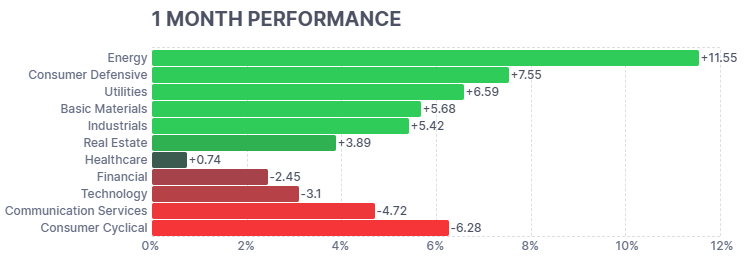
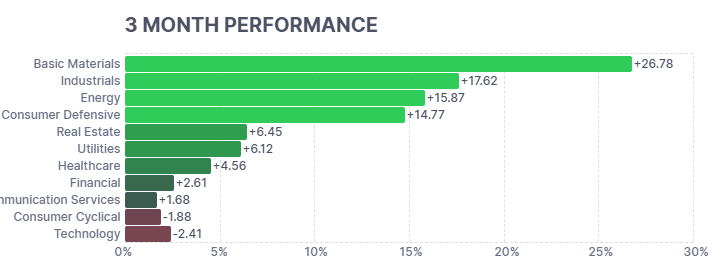
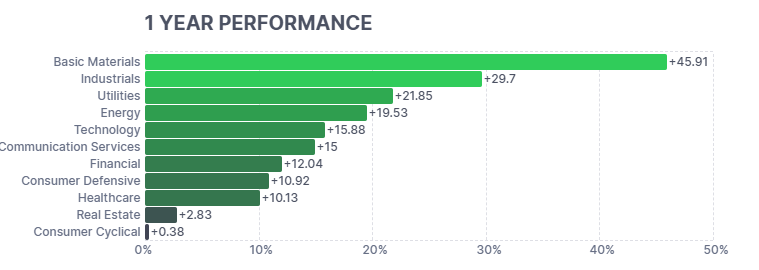 Source Link for Monitoring monthly rotation.
There are multiple ways to use the weekly, monthly or quarterly performance information above as a portfolio management system.
One such way is to use ETFs that focus on each of the 11 sectors but only own the top five performing sectors.
Each month look at the monthly “Top Five Performers” and own them for the next week, month or quarter – you decide the turnover rate. Out opinion is weekly is too frequent. Monthly or quarterly is ok.
Each month or quarter you would review the Top Five Sectors for performance and eliminate the ETFs in the sectors that fall from grace (fall out of the top five positions) and buy ETFs in the new sector additions to the Top Five Performer list. A desirable outcome is to catch long-term trends where the sector stays in the top five grouping for an extended timeline, so you don’t have much activity. You could shorten this to a weekly review or lengthen the review to every three months. You decide the duration of the reviews and position changes.
Below we have screened Multiple ETFs that fit in the current Top Five Monthly Performers (as shown above) to give you a head start.
Strategy options to consider might be to buy multiple ETFs in each sector with either targeted or a broad based approach or a mix of the two within that sector. The more conservative you want to be, the broader the coverage of the ETF selected should be.
I: ENERGY
The following are five of the top energy ETFs as of February 2026, selected based on their total assets, market popularity, and 1-year performance.
- Energy Select Sector SPDR Fund (XLE): The largest and most popular energy ETF, tracking the energy sector of the S&P 500. It is highly concentrated in oil and gas giants like ExxonMobil and Chevron.
- Vanguard Energy ETF (VDE): A broadly diversified fund that tracks over 100 U.S. energy stocks across large-, mid-, and small-cap companies.
- Alerian MLP ETF (AMLP): The leading ETF for Master Limited Partnerships (MLPs), focusing on energy infrastructure such as pipelines and storage.
- VanEck Oil Services ETF (OIH): A targeted fund tracking U.S.-listed companies that provide equipment and services to oil and gas producers.
- iShares Global Clean Energy ETF (ICLN): One of the largest clean energy ETFs, providing global exposure to companies involved in solar, wind, and other renewable sources.
II: CONSUMER DEFENSIVE:
The top five ETFs for the consumer defensive (staples) sector, known for providing exposure to essential, non-discretionary goods, include XLP, VDC, FSTA, IYK, and KXI. These funds typically hold large-cap stocks like Procter & Gamble, Walmart, and Coca-Cola, offering stability with low-cost options often having expense ratios below
 Here are the top five Consumer Defensive ETFs:
- Consumer Staples Select Sector SPDR Fund (XLP): Often considered the benchmark for the sector, this ETF has high liquidity and concentrates on the largest U.S. staples companies, with roughly 62.7% of its assets in its top 10 holdings.
- Vanguard Consumer Staples ETF (VDC): A popular, low-cost option that covers a broader range of U.S. consumer staples, including mid- and small-cap companies in addition to large-caps.
- Fidelity MSCI Consumer Staples Index ETF (FSTA): Similar to VDC, this ETF offers low expense ratios (approx.) and tracks a broad, market-cap-weighted index of U.S. staples.
- iShares U.S. Consumer Staples ETF (IYK): Tracks an index of U.S. companies that produce essential goods, offering similar exposure to XLP but with slightly different weighting methodologies.
- iShares Global Consumer Staples ETF (KXI): Provides global exposure to the consumer staples sector, making it ideal for investors seeking to diversify outside of U.S.-only stocks.
III: UTILITIES
The following exchange-traded funds (ETFs) are consistently ranked among the top options for the utility sector as of early 2026, based on assets under management (AUM), expense ratios, and performance.
Top 5 Utilities ETFs
- Utilities Select Sector SPDR Fund (XLU)
- Description: The largest utility ETF, tracking the Utilities Select Sector Index, which includes companies from the S&P 500.
- Expense Ratio: 0.08%.
- Yield: Approximately 2.24% – 2.6%.
- Focus: Broad-based U.S. electric, gas, and water utilities.
- Vanguard Utilities ETF (VPU)
- Description: Tracks the MSCI US Investable Market Index (IMI)/Utilities 25/50, providing broader exposure than XLU by including small- and mid-cap companies.
- Expense Ratio: 0.09%.
- Focus: Low-cost, diversified exposure to the entire U.S. utility market.
- Fidelity MSCI Utilities Index ETF (FUTY)
- Description: A competitive low-cost alternative tracking the MSCI USA IMI Utilities Index.
- Expense Ratio: 0.08%.
- Focus: Captures approximately 98% of the investable U.S. utility market.
- iShares U.S. Utilities ETF (IDU)
- Description: Tracks the Russell 1000 Utilities RIC 22.5/45 Capped Index, focusing on large-cap U.S. companies.
- Expense Ratio: 0.38%.
- Focus: Targeted exposure to major domestic power and water infrastructure.
- First Trust Utilities AlphaDEX Fund (FXU)
- Description: An “AlphaDEX” fund that uses fundamental growth and value factors rather than market-cap weighting to select stocks.
- Expense Ratio: 0.61%.
- Performance Note: Often highlighted for potentially higher returns through its smart-beta approach.
IV: BASIC MATERIALS:
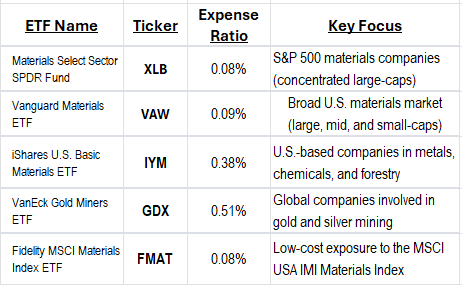
The following five ETFs are among the largest and most prominent funds providing exposure to the basic materials sector in 2026, based on assets under management (AUM) and market relevance.
Top 5 Basic Materials ETFs
Key Highlights for Investors
- Cost Efficiency: XLB and FMAT offer the lowest expense ratios in the sector at 0.08%, making them highly efficient for long-term core holdings.
- Diversification: While XLB is limited to approximately 29 large-cap S&P 500 stocks, VAW provides broader exposure with over 115 holdings across various market capitalizations.
- Targeted Exposure: For investors seeking specific sub-sectors, GDX focuses exclusively on gold mining, which often behaves differently than the broader materials market due to its tie to gold prices.
- Recent Performance: As of February 2026, many materials ETFs have shown strong year-to-date (YTD) returns, with XLB and VAW both exceeding 15% gains early in the year.
V: INDUSTRIALS
The top five ETFs for the industrial sector, based on performance, assets, and popularity, include the Industrial Select Sector SPDR Fund (XLI) (broad, high liquidity), Vanguard Industrials ETF (VIS) (low cost), and niche leaders like the iShares U.S. Aerospace & Defense ETF (ITA), Global X U.S. Infrastructure Development ETF (PAVE), and First Trust RBA American Industrial Renaissance ETF (AIRR).
Top 5 Industrial Sector ETFs:
- Industrial Select Sector SPDR Fund (XLI): The largest and most liquid, tracking S&P 500 industrials.
- Vanguard Industrials ETF (VIS): A low-cost, broad-based fund providing comprehensive exposure to U.S. industrial companies.
- iShares U.S. Aerospace & Defense ETF (ITA): Focuses heavily on defense and aerospace, offering high performance in this subsector.
- Global X U.S. Infrastructure Development ETF (PAVE): Tracks companies involved in infrastructure development, including engineering and raw materials.
- First Trust RBA American Industrial Renaissance ETF (AIRR): Invests in small/mid-cap industrial and community banking companies, focusing on the U.S. industrial renaissance.
To source additional ETFs for the remaining sectors simply do a search with the following description inserting the sector specific you desire –
List the Top Five ETF in the (INSERT TITLE HERE) sector based on size, popularity and 1-year performance.
Simple and effective.
We suggest buying at least two ETFs per sector and preferably three. This gives you more exposure yet would allow you to have one narrow and sub-sector focused and a second or second and third broader based exposure. You decide.
Hope this is of help.
LOTM Research & Consulting Service
* An account related to LOTM holds a position in this security.
Neither LOTM nor Tom Linzmeier is a Registered Investment Advisor.
Please refer to our web site for full disclosure at www.LivingOffTheMarket.com ZTA Capital Group, Inc.
To Unsubscribe please select “return” and type Unsubscribe in the subject line..
