
- MARKET ROTATION HAPPENING – WHERE TO BE POSITIONED?
- Where AI and Blockchain meet: Bittensor (TAOUSD) $175.00
MARKET ROTATION HAPPENING – WHERE TO BE POSITIONED?
AI’s Expansion Is Dependent on Crypto and Blockchain
Artificial intelligence cannot achieve meaningful expansion without the foundational support of crypto and blockchain technologies.
Why Is This the Case?
Time: Traditional financial systems are unable to keep pace with the rapid changes driven by AI agents. The transition from fiat currency to stablecoin payment systems, along with the tokenization of a wide array of assets—including stocks, bonds, commodities, currencies, real estate, and retail transactions—is now in full effect. This shift enables transactions and processes to occur at speeds and levels of automation that traditional finance cannot match.
Authentication: There is a need to authenticate both human and AI Agents when making payment. Blockchain and encryption provide the level of security needed for this new system to function at the speeds available.
This perspective has been echoed by numerous thought leaders in the industry, each articulating the necessity of blockchain and crypto for AI’s continued growth in their own way.
Strategic Positioning Amid Disruption
Market Rotation Happening – Where Should Investors Be Positioned?
The financial landscape is undergoing a significant transition, driven by rapid advances in artificial intelligence (AI), cryptocurrency, and blockchain technologies. Understanding these shifts is crucial in identifying the best sectors for investment and those to avoid.
AI Cannot Expand Without Crypto and Blockchain
The continued growth and advancement of AI are increasingly dependent on the infrastructure provided by crypto and blockchain. Traditional finance systems cannot adapt quickly enough to the sweeping changes brought about by AI agents. The transition from fiat to stablecoin payment systems and the tokenization of assets—including stocks, bonds, commodities, currencies, real estate, and retail transactions—has become a widespread trend. Multiple industry leaders have recognized and commented on this evolution:
- Jeff Currie, partner at Carlyle and former partner/department head at Goldman Sachs
- Ben Horowitz, cofounder and general partner at the venture capital firm Andreessen Horowitz “Cryptocurrency serves as the natural currency for artificial intelligence.”
- Paul S. Atkins, former Head of the Securities & Exchange Commission (SEC)
- Larry Fink, co-founder, chairman, and CEO of BlackRock, the global leader in assets under management (AUM)
- Salim Ismail (founding executive director of Singularity University) breaks down the massive economic transition now underway as advanced technologies push society from a scarcity-based system to one of abundance.
Sectors Facing Margin Compression from AI Disruption
AI is anticipated to erode margins by eliminating high-fee intermediaries, commoditizing formerly proprietary services, and altering software pricing models.
Legacy Software and SaaS: Traditional software companies—including Salesforce, Workday, and ServiceNow—are seeing their business models challenged. AI-driven productivity decreases the need for large workforces, reducing demand for traditional per-seat licensing. Additionally, the shift from CPU-based to GPU-based software is expected to slow revenue growth and introduce new marginal costs for each “agentic” action, leading to margin compression.
- Intermediaries and Professional Services: AI is replacing human intermediaries with automated systems that optimize price and fit. The most affected sectors include:
- Financial Services: Financial advisors, CPAs, and insurance agents are experiencing declining prices and margins as AI agents automate complex tasks.
- Real Estate: AI-powered tools are streamlining property valuations, market research, and leasing, threatening high-fee costs like title searches and legal negotiations.
- Legal Services: AI is increasingly used for document review and standardized analysis, reducing billable hours and revenue per matter.
- Customer Experience Outsourcing: Sub-sectors focusing on labor-based contact handling face heightened risk as AI enables companies to insource these functions through automation and advanced speech analytics.
- Logistics and Transportation: Freight brokers and intermediaries are pressured by scalable tools that increase freight volumes without additional headcount, leading to aggressive competition for market share at the expense of short-term margins.
Risks from a Hyperscalers Build-out Slowdown
A reduction in infrastructure investment by tech giants (Hyperscalers) would immediately impact the hardware and semiconductor supply chain.
- Semiconductor and Hardware Manufacturers: Companies like Super Micro (SMCI) have seen declining gross margins—from 12% to 6.4%—due to intense competition for Hyperscalers contracts. With major customers accounting for over 60% of revenue, any decrease in Hyperscalers capex could pose catastrophic risks to future orders and profit growth.
- Cloud Service Providers (Hyperscalers): Firms such as Microsoft, Amazon, and Google face diminishing marginal returns on capital employed (ROCE). Large capex spending leads to higher depreciation expenses, which may become a headwind for earnings growth if sales fail to keep pace.
- IT Channel Partners: Although overall IT spending is increasing, the proportion delivered through traditional channel partners has dropped from over 70% to 61% in four years, as Hyperscalers and enterprises move away from conventional sales funnels.
Sectors to Focus On
- Healthcare & Life Sciences: Expected to undergo profound transformation by 2026, with AI accelerating drug discovery, enhancing diagnostic accuracy through advanced medical imaging, and enabling personalized treatment plans based on genetic information.
- Energy: Near-term opportunities include all form of existing sources of energy. Natural Gas is an easy choice as it can be rapidly expanded as well as in abundance. Focus more on volume providers than depending on rising prices per unit. For long-term prospects, focus on space-based solar generation and nuclear energy.
- Hard Assets (Metals): Examples include Gold, Silver, Copper, and Rare Earth metals. Materials essential for space-based solar power generation include high-efficiency, radiation-hardened materials such as Gallium Arsenide (GaAs) and hard to source, high-purity purified phosphoric acid (PPA), used in Lithium Iron Phosphate (LFP) battery production.
- Chemical Companies and Oil & Gas Refinery Industries: These sectors are expected to experience strong demand and are unlikely to be disrupted by AI, crypto, or blockchain innovations.
- Foreign Countries: Countries with robust commodity production, younger populations, and efficient infrastructure for sourcing, warehousing, transportation, and shipping—such as Brazil, Canada, Australia, Chile, and Mexico—are favorable for investment.
- Companies Developing Applications Utilizing Crypto/Blockchain and AI: Areas driving positive disruption include robotics, space, life sciences, and artificial general intelligence (AGI). AGI systems are anticipated to handle most economically valuable work currently performed by humans. Sectors likely to be disrupted include finance, insurance, accounting, legal, medicine, and coding.
- Cyber Security: As AI technologies evolve in 2026, cybersecurity is necessary to counter an “AI arms race” where attackers use machine speed and automation to outpace traditional defenses. Modern cybersecurity acts as both a shield against new AI-driven threats—such as hyper-realistic deepfakes and autonomous malware—and a critical framework for securing the AI models themselves from manipulation.
Where AI and Blockchain meet: Bittensor (TAOUSD)
About Bittensor: Bittensor (TAO) is a decentralized, open-source blockchain protocol that creates a peer-to-peer marketplace for artificial intelligence (AI) and machine learning (ML) models. By utilizing a subnet architecture, it allows participants to contribute AI computing power and models to a collective, incentive-driven network, earning TAO tokens for valuable contributions, thus democratizing AI development
As of March 1, 2026, Bittensor ($TAO) has seen significant subnet growth, outpacing many other decentralized AI networks through a specialized architecture that incentivizes “machine intelligence” rather than just raw compute power.
Subnet Ecosystem Expansion
The network currently supports 128 to 129 active subnets. Key growth factors include:
- Subnet Cap Expansion: There is active community discussion and planning to double the subnet limit from 128 to 256 to accommodate more specialized AI markets.
- Dynamic TAO (dTAO): This 2025/2026 upgrade transformed subnets into directly investible markets, allowing stakers to swap TAO for “alpha” subnet tokens.
- Usage Surge: Recent reports indicate a 34% week-over-week increase in subnet usage as of mid-February 2026, driven by real-world utility in areas like serverless AI compute and autonomous coding agents.
Comparison with Other Networks
While networks like Render and Akash focus on the decentralized marketplace for GPUs, Bittensor’s growth is tied to the collaboration of machine learning models.
- Decentralized Intelligence vs. Compute: Bittensor acts as an incentive layer for AI output rather than just hardware.
- Institutional Adoption: Adoption has been bolstered by Grayscale’s efforts to convert its Bittensor Trust into an ETF, providing a regulated vehicle that many competing protocols currently lack.
Financial Snapshot (March 1, 2026)
- Current Price: Approximately $181.32 – $182.66.
- Market Sentiment: Short-term bullish as the market absorbs the December 2025 halving, which reduced daily emissions from 7,200 to 3,600 TAO.
- Supply Dynamics: Reduced sell pressure and increased staking demand (with ~179M daily trading volume) suggest a shift toward institutional accumulation.
TAO Market Performance and Forecast (Early 2026)
Analysts suggest that if Bittensor maintains its current trajectory and successfully expands its subnet cap, the price of TAO could potentially target the $500 to $850 range later in 2026 as reduced supply and increased subnet utility converge.
Bittensor (TAO) Price Prediction 2026-2030: Decentralized AI’s Scarcity Play
Published early February 2026 – CoinClub
Bittensor is trying to become the settlement layer for intelligence itself. Models, compute, data, and incentives all meet inside the same market. That distinction is important when thinking about price, especially after the December 2025 halving.
TAO is capped at 21 million tokens. Emissions were just cut in half. At the same time, regulated institutional access is starting to form. This is the first moment where all three forces exist together.
Bittensor Overview
TAO enters 2026 in a strange but constructive position. Price is hovering around $285 (LOTM Insert – March 1, 2026 price $175ish) . That is more than 60% below the 2024 all-time high, yet still multiples above the 2023 lows. The long correction already played out. The halving already happened. The network did not stall. It expanded.
That combination usually shows up before repricing.
The market spent most of 2025 digesting excess emissions and speculative froth. Now daily issuance sits at 3,600 TAO instead of 7,200. That change has not fully filtered into circulating supply yet. It takes time for reduced emissions to translate into thinner sell-side pressure.
For 2026, the base expectation is absorption. Less new TAO entering the market, more TAO locked in staking and subnets, and a growing narrative around institutional access. A price range between $500 and $850 is realistic if those dynamics hold. Looking further out, if Bittensor establishes itself as a neutral intelligence layer outside Big Tech, the supply math supports much higher valuations by the end of the decade.
At current levels, TAO trades with a market cap near $3 billion on roughly half of its total supply. The scarcity is already visible. It just has not been fully priced yet.
Fundamental Catalysts
Most AI-related tokens move with narrative shifts. TAO moves with mechanics. That usually makes price action look slow, until it suddenly is not. (Source Link)
Two year weekly chart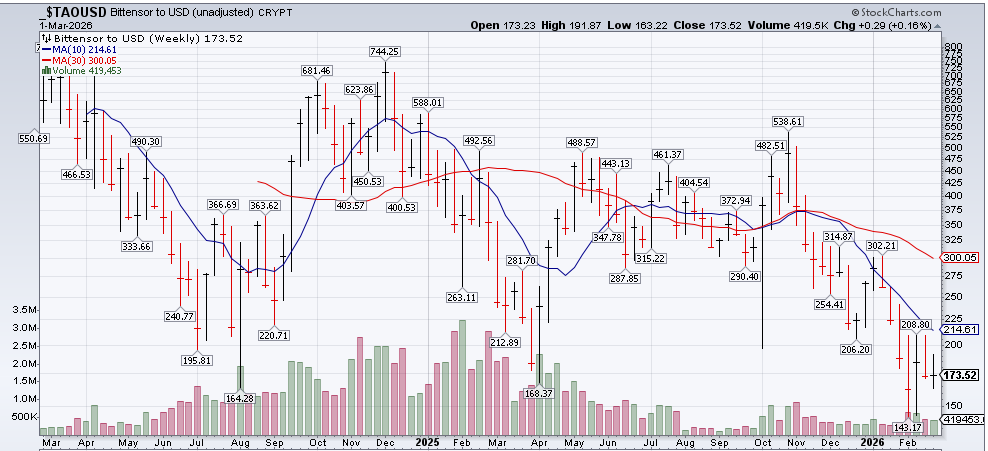
There are very few Equity plays related to Bittensor. This of you who are regular readers know our favorite choices. There are two crypto ETFs that have file with the SEC to be the first two ETFs holding the Bittensor altcoin.
LOTM Research & Consulting Service
* An account related to LOTM holds a position in this security.
Neither LOTM nor Tom Linzmeier is a Registered Investment Advisor.
Please refer to our web site for full disclosure at www.LivingOffTheMarket.com ZTA Capital Group, Inc.
To Unsubscribe please select “return” and type Unsubscribe in the subject line..
