
There is a new investment theme that is well under way. This new theme is the emergence of Crypto miners as AI’s new Critical Infrastructure. See headline below.
A number of Crypto Miners have made significant stock price moves higher this year. IREN is mentioned below as having made a 600% rise in 2025. I am making the judgement call that there are additional crypto miners that have not moved higher that could make large moves higher.
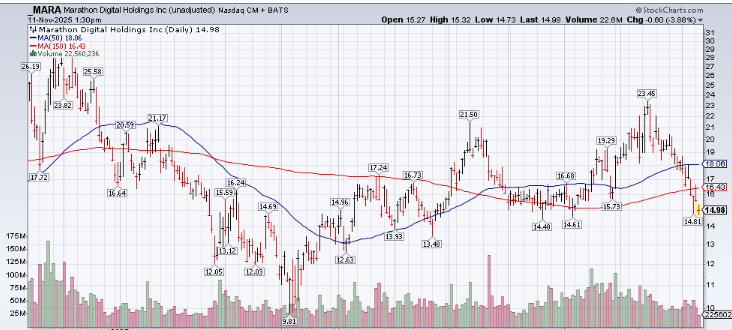
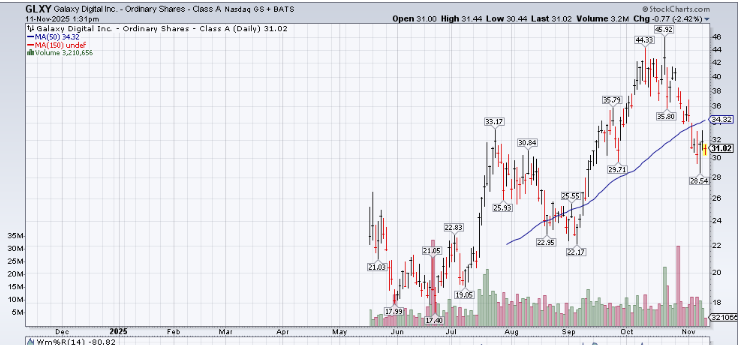
At the top of my list is MARA Holdings (MARA*) $14.94. MARA’s management has been talking about being a Critical Energy Infrastructure company more than a crypto miner since early 2024. Galaxy Digital (GLXY*) has also emerged as an AI Critical Infrastructure Company as well. Both MARA and Galaxy are positions held in related accounts to LOTM.
The current correction in Crypto/Blockchain related sector is presenting a pullback buying opportunity in MARA and Galaxy Digital. See charts at the end of this article.
Microsoft’s $9.7B Bet Just Proved Bitcoin Miners Are AI’s Critical Infrastructure
Benzinga – 10:29 AM EST, 11/10/2025
As most investors chase GPU allocation, the scarcity is electrical capacity. See how Bitcoin miners became the infrastructure gatekeepers.
Bitcoin mining stocks rallied in 2025, with IREN up 600% and others climbing triple digits. Wall Street’s initial reaction saw this as another crypto bubble. But in reality, Microsoft (MSFT) just paid $9.7 billion to prove it wasn’t. The buyer wasn’t interested in Bitcoin. It wanted something far scarcer: grid-connected electrical capacity and the infrastructure to deploy AI at scale. Bitcoin miners happen to control a meaningful share of it.
The 5-Year Problem No One Talks About
When Amazon, Microsoft, or Google moves to build a new AI data center, the first step is an interconnection request to the local utility. The next step is waiting.
Average grid interconnection timelines in the U.S. have stretched to five to seven years, according to FERC data. A single hyperscale AI site can require one to two gigawatts of capacity, enough to power hundreds of thousands of homes, which can push timelines even longer. Transformer components alone face multi‑year backlogs.
Meanwhile, projected AI data center power demand rises from about 4 gigawatts in 2024 to roughly 123 gigawatts by 2035, a 30x increase, per Deloitte. Even if approvals started today, supply would lag demand well into the 2030s.
This is what will shape the AI race: not who builds the best model or buys the most GPUs, but who can connect power to racks on a short clock.
Enter an unlikely group of infrastructure owners: Bitcoin mining companies.
The Accidental Infrastructure Advantage
Miners did not set out to control AI infrastructure. They chased cheap power for energy‑intensive mining, often in remote regions. They co‑located by hydro in Paraguay, geothermal in Iceland, and wind in West Texas. They went where electricity was stranded and priced below the grid.
Along the way they solved the exact problem now slowing AI deployments. They already own substations, grid interconnections, and long‑term power contracts. Those take years to secure from scratch.
Public Bitcoin miners collectively control roughly 14 gigawatts of grid‑connected capacity. That is more than 10% of the AI data center capacity projected through 2030, already wired and running. Converting these sites to AI workloads can take nine to twelve months, not half a decade.
The market has noticed. When IREN disclosed its Microsoft agreement in November, the contract economics were AI infrastructure, not crypto. Microsoft will pay about $1.94 billion per year over five years, consistent with hosting roughly 1,300 megawatts of AI compute. IREN’s market value moved from about $7 billion to $16.5 billion after the news, a 135% re‑rating tied to power infrastructure, not Bitcoin.
Valuation frameworks are shifting with it. Miners pivoting to AI are trading near $6 million per megawatt of capacity, while pure Bitcoin miners sit closer to $3 million. The premium reflects a simple idea: reliable power and grid access are more valuable than the coins those facilities once mined.
The Difficulty Squeeze
As of early November 2025, Bitcoin network difficulty sits near 155.97 tera-hashes, a record. At that level, many U.S. grid‑rate miners break even around $111,000 per Bitcoin. Margins narrow, and only the most efficient operations stay profitable. For many, an AI pivot is not a side project. It is the path to sustainable cash flow.
This is where a dual‑engine model becomes attractive. Mining provides near‑term cash generation and optionality. AI hosting and high‑performance computing shift the long‑term value driver to recurring revenue.
See Charts for MARA HOLDINGS and GALAXY DIGITAL below:
LOTM Looks to buy companies first and then trade the stock. We lean into dollar-cost-averaging (DCA) and long-term capital gains as part of our position management plan.
Another part of our risk managemenrtplan is to reduce the number of positions held during market corrections and redeploy the proceeds into our highest conviction positions. MARA and Galaxy are among our highest conviction positions.
LOTM Research & Consulting Service
* An account related to LOTM holds a position in this security.
Neither LOTM nor Tom Linzmeier is a Registered Investment Advisor.
Please refer to our web site for full disclosure at www.LivingOffTheMarket.com ZTA Capital Group, Inc.
To Unsubscribe please select “return” and type Unsubscribe in the subject line.
